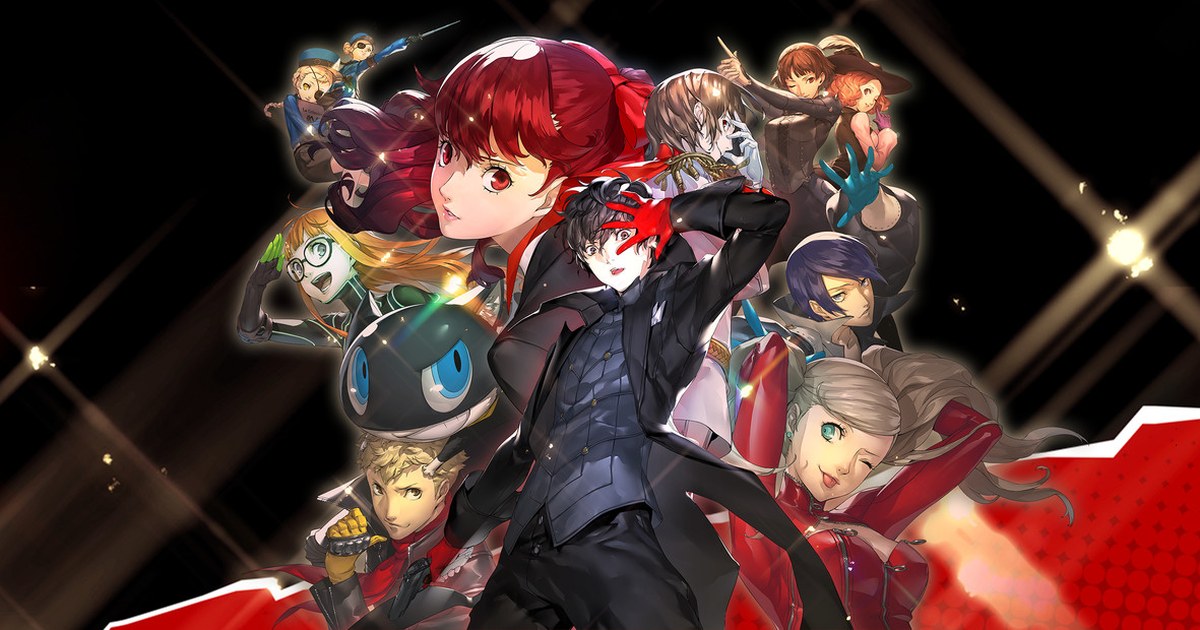
Persona 5 Royal
Verdict: Persona 5 Royal is the original Persona 5 with a new semester, new characters and new endings, and almost all of it is untouched. The one real woke change is in the English localisation only: Atlus West rewrote the two short scenes where a pair of gay men accost Ryuji, changing what they want from him and giving them names, to stop portraying them “in a negative light”. The Japanese script kept the original scenes. Female characters, costumes and the M rating are intact, and there’s no DEI consultancy. It’s a targeted localisation edit made for representation reasons, not an agenda rewrite of the game.
Woke Score: 22/100. The English rewrite changes the meaning of the Japanese for openly stated representation reasons, and Atlus West sold it to the press as “a chance to make it right”. Atlus has since made similar edits in its own Japanese scripts, and the 2022 ports quietly removed Rising Sun imagery worldwide. What keeps it in the low 20s: two short scenes with minor characters, the Japanese text is untouched, the original Persona 5 English still exists, the fanservice and adult themes are all there, and a progressive outlet attacked the rewrite as a failure (rule D).
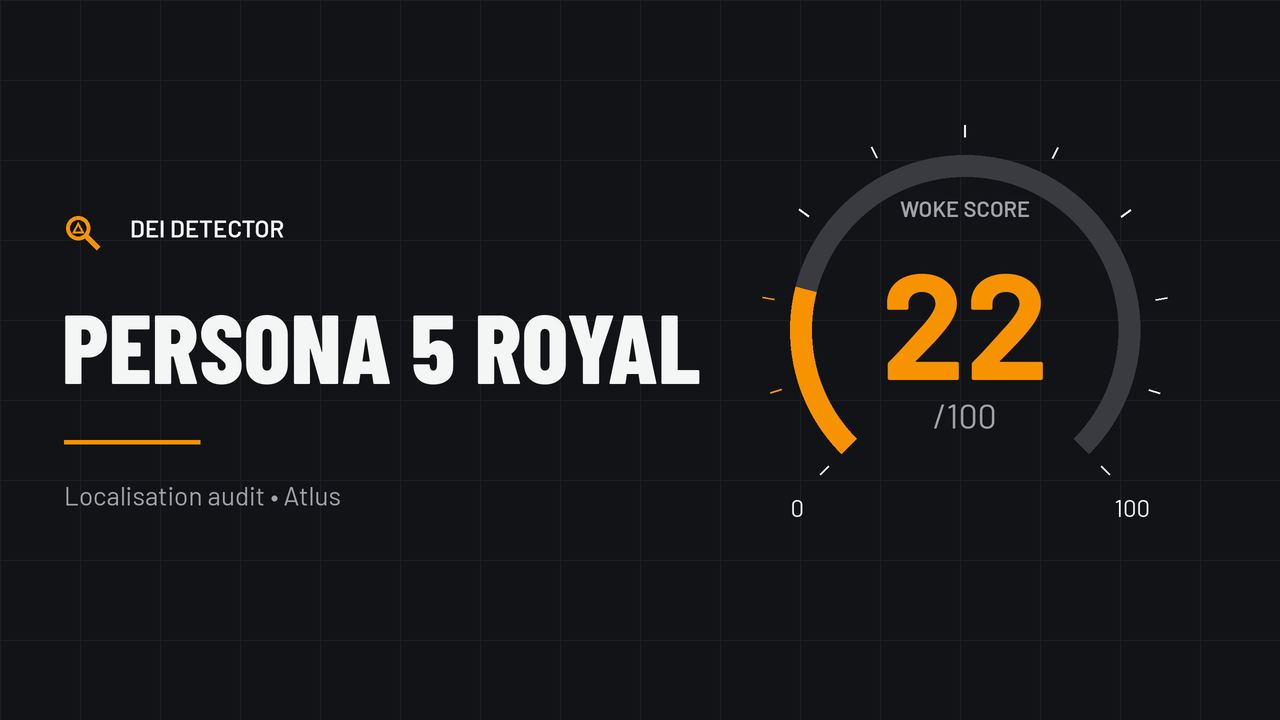
Woke Score graphic
This is the standing page for Persona 5 Royal (PS4 2019 in Japan, 2020 worldwide; PS5, Switch, Xbox and PC in 2022). New evidence gets merged here; the URL stays fixed. Sibling Atlus pages: Persona 3 Reload, Persona 4 Revival and Metaphor: ReFantazio.
How the score breaks down
Scored against our How we score rules:
- Woke localisation (English only), +15. What changed: the Shinjuku scene and the 29 August beach scene with two gay men who pester Ryuji. In Persona 5 they approach him out of attraction and are played as predatory; in Royal’s English they’re named Angel and Julian, they approach him because he peeked into the Crossroads bar, and they want to put him in drag (GameSpot, Polygon). Who and why: Atlus West’s localisation team. Senior project manager Yu Namba said the originals were “portrayed [as] more like predatory” and that “the community had a very strong response”; communications manager Ari Advincula said the lines were updated “for the current generation” so the men were no longer shown in a “negative light” (GameSpot, IGN, Feb 2020). The Japanese Royal kept the original scenes (IGN, Siliconera, Censorship Wiki). A localisation that rewrites the source’s meaning for representation reasons is exactly what our base rules flag. It isn’t higher because the two men are minor characters in two short scenes, and nothing else in the script was changed for political reasons.
- Publisher PR framing, +5. Atlus West didn’t just make the edit, it campaigned on it. Advincula called Royal “a chance to make it right” and said fixing these scenes was “one of the first things” she asked about when she joined (IGN). That’s a public representation pitch to the Western press around the release, separate from the edit itself.
- Track-record rule (rule B), +5 for Atlus. Documented reasons: Atlus Japan rewrote Persona 3 Reload’s trans-woman beach gag in both languages in 2024 (see Persona 3 Reload), and it has confirmed “world we live in now” edits for Persona 4 Revival (see Persona 4 Revival). Royal’s English rewrite was where the pattern started.
- 2022 ports: Rising Sun imagery removed worldwide, +2. The Switch, Xbox and PC versions use the Korean-market assets everywhere: the Rising Sun motif is gone from Ryuji’s shoes and the Almighty skill icon was redrawn (Censorship Wiki; fan comparisons). It’s censorship of existing art in a re-release, but it’s tiny, and the reason is East Asian political sensitivity, not a Western progressive message, so it only counts a little.
- Rule D (green flag), −5. Polygon ran “Atlus tried, and failed, to fix Persona 5’s most controversial scene” (31 Mar 2020), arguing the rewritten scene is “still troubling” because the men still ignore Ryuji’s objections. A progressive outlet attacking the result counts once, at the low end because it’s one outlet.
- Consultancy check (rule A): none found. Royal isn’t in Sweet Baby Inc.’s documented gameography or on the “Sweet Baby Inc detected” Steam curator’s current list. The credits (MobyGames) list the Sega of America localisation staff and the vendors Synthesis, Keywords Studios Montreal, XLOC, Miraesoft and ENSIDE, with no content-review, sensitivity or culturalisation role, and no report names an outside DEI or sensitivity firm.
- Possible influence (not scored): Atlus West’s “internal content review team”. In IGN’s preview report (Tom Marks, 17 Feb 2020), Atlus communications manager Ari Advincula “explained that their localization team has an ‘internal content review team’ she described as ‘very on the pulse about what’s right and what to do.’” That’s the Western localisation arm (Atlus USA, credited as Sega of America), not Atlus Japan or Sega corporate, and she said it in the same interview where she announced the Angel and Julian rewrite. PlayStation LifeStyle paraphrased that “scenes like these are the primary focus” of the team, and Kotaku attributed the “chance to make it right” line to it, though IGN attributes that line to Advincula herself. That’s enough to flag. It isn’t scored because no source says what the team actually does (DEI or sensitivity review, or ordinary ratings and content checks), and none says it made or ordered this change. Yu Namba’s own account is that the localisation team pushed for the rewrite after consulting “the production department” and “our marketing” (GameSpot). The rewrite itself is already scored above, so this line adds 0.
- Remake rule (rule C): Royal is an expanded re-release, and the only content change we could confirm in the Japanese version is new content, not removed or softened content. The English change is scored above as localisation, so it isn’t counted twice.
- Rule E (feminism): neutral, not scored. Ann, Makoto, Futaba, Haru and new girl Kasumi are capable Phantom Thieves who are also attractive and romanceable by the male lead, in the JRPG tradition. That’s the expected kind of strong women, so it neither adds nor takes off points.
Confirmed: the gay-men scenes were rewritten in English only
In Persona 5 (Japan 2016, West 2017), two flamboyant men approach Ryuji in Shinjuku after overhearing him, and his “lemme go!” implies they grab him; they turn up again at the beach later in the summer. The scenes were criticised in the West for presenting the game’s most visible gay characters as sexually aggressive toward a teenager.
In Persona 5 Royal’s English script:
- The men are named Angel and Julian (“or Julie, if you’re feeling saucy”).
- They approach Ryuji because they saw him walk up to Crossroads, the Shinjuku crossdressing bar, and walk away. They want to get him into drag, not pick him up.
- Ryuji no longer says “lemme go”, so the suggestion that they grab him is gone (GameSpot’s side-by-side). Polygon notes they still push him into something he doesn’t want to do.
- The beach scene was reworked along the same lines.
The Japanese Royal wasn’t changed. IGN reported that the conversations were “generally unaltered in Japanese”, Siliconera wrote that “the characters in question remain unchanged in the Japanese release”, and the Censorship Wiki lists the edit as international-only. Namba said it wasn’t easy to get the green light for the change (Persona Central’s summary of the GameSpot interview), which fits a Western-branch request signed off in Japan rather than a change to the Japanese master script. That’s why Japanese text or the original Persona 5 English are the clean ways to see the scene.
Forbes (Erik Kain) argued at the time that this “isn’t censorship”. Under our rules it doesn’t need to be: an English script rewritten to change what the Japanese says, for representation reasons, is woke localisation.
Confirmed: 2022 ports use censored East Asian assets everywhere
The October 2022 Switch, Xbox and PC versions ship with the Korean-market art worldwide: the Rising Sun motif on Ryuji’s shoes is gone and the Almighty skill icon was redrawn. The Raidou Kuzunoha costume DLC wasn’t released on the new platforms and was delisted from PlayStation stores on 15 October 2022 (Censorship Wiki). Atlus gave no reason for the Raidou removal. Fans speculate it’s because the outfit looks like an Imperial Japanese Army uniform, but licensing is just as possible, so we don’t score it. The original 2017 Persona 5 already had the Rising Sun removed in its Korean release only.
Checked and not confirmed (or ruled out)
| Talking point | Finding |
|---|---|
| Royal’s Japanese script also rewrote the gay-men scenes | Ruled out. IGN, Siliconera and the Censorship Wiki all say the Japanese version kept the originals. |
| Female characters’ outfits or fanservice censored | Ruled out. Swimsuits, the Kawakami maid storyline, Ann’s modelling subplot and the Phantom Thief outfits are unchanged, and Royal keeps the ESRB M rating like the original. |
| Whole English script re-translated with woke language | Ruled out. Namba described a consistency and pronunciation pass plus new recording for new content; no inclusive-language or political rewrite beyond the two scenes has been documented. |
| Kawakami, Ohya, Makoto or Ann dialogue softened | No documented change. We found no press or side-by-side evidence of political edits to these characters. Fan anecdotes about small wording differences aren’t enough. |
| Lala Escargot / Crossroads toned down | Ruled out. The bar and its owner are unchanged; Royal actually leans on Crossroads more, as the new setup for the Angel and Julian scene. |
| Raidou DLC pulled for politics | Unverified. No official reason; not scored. |
| Royal’s new content (Kasumi, Maruki, third semester) adds a DEI message | Ruled out. The new story is about grief, escapism and a benevolent-looking false reality. No identity politics. |
Cleanest version and regional notes
- Persona 5 (PS3 / PS4, 2017 English) has the unedited English of the two scenes. It doesn’t have Royal’s new content.
- Persona 5 Royal in Japanese (PS4, Japanese text and audio) has all the Royal content with the original scenes. The Censorship Wiki lists the Japanese Royal as the only uncensored Royal release. Note: the Western Royal’s Japanese-audio option doesn’t help, because the English subtitles still use the rewritten script.
- Persona 5 Royal on PS4 (Western) is the best Western Royal build: it keeps the Rising Sun art, and the Raidou DLC was available before it was delisted. The 2022 Switch, Xbox and PC ports use the edited art, and PC mods can restore it.
Every region’s Royal has the same female character presentation. The only regional differences we found are the English-only scene rewrite and the Rising Sun edits.
Compared with the site’s other Atlus pages, Royal scores below Persona 3 Reload (37), Persona 4 Revival (53) and Metaphor: ReFantazio (63). Royal’s edit was only in the English script, so the Japanese game and the original English release are still there untouched. Reload’s rewrite went into Atlus Japan’s own script, so no version of Reload has the original.
DEI Detector scorecard
| Signal | Present? |
|---|---|
| English-only rewrite of the gay-men scenes, meaning changed vs Japanese | Strong (woke localisation, +15; two short scenes, minor characters) |
| Publisher PR framing (“a chance to make it right”) | Present (+5) |
| Publisher track record (Atlus: P3R 2024, P4R 2026) | Present (rule B, +5) |
| Global Rising Sun removal in 2022 ports | Present, minor (+2) |
| Raidou DLC removal | Present, reason unknown (not scored) |
| DEI / sensitivity consultancy credited | Not found |
| Internal content review team (Atlus West) | Possible influence, not scored (existence confirmed; role and effect on this rewrite not confirmed) |
| Sexual / feminine censorship of the female cast | Not found |
| Progressive press attack on the rewrite (Polygon) | Green flag (rule D, −5) |
| Strong, attractive women in the main party (JRPG tradition) | Neutral (rule E, not scored) |
| Pronouns menu, queer-representation packaging, DEI marketing | Absent |
Open to update
This page will be revisited if:
- A full P5 vs P5R English script comparison turns up more politically motivated rewrites (the score rises).
- Reporting confirms Atlus West’s internal content review team is a DEI or sensitivity team and that it drove the Angel and Julian rewrite (rule A would apply).
- Atlus explains the Raidou DLC removal.
Sources: GameSpot interviews with Yu Namba (Feb 2020) and GameSpot’s side-by-side of the rewritten scenes; IGN (Tom Marks, 17 Feb 2020) with Ari Advincula; Siliconera (Mercedez Clewis, 18 Feb 2020); Persona Central’s roundup of the P5R media event (18 Feb 2020); Polygon, “Atlus tried, and failed, to fix Persona 5’s most controversial scene” (31 Mar 2020); PlayStation LifeStyle (18 Feb 2020) and Kotaku (Luke Plunkett, 17 Feb 2020) on the content review team; MobyGames credits; Forbes (Erik Kain, 18 Feb 2020); the Censorship Wiki’s Persona 5 page (international and South Korean censorship, 2022 ports, Raidou DLC); Persona Central on the Korean Persona 5 shoe edit. Scoring evidence: Kotaku, PC Gamer and TheGamer on Persona 3 Reload; Anime Corner, Kotaku and Push Square on Persona 4 Revival; Wikipedia’s Sweet Baby Inc. gameography and the “Sweet Baby Inc detected” Steam curator list (checked 26 Sep 2026). Anything marked “confirmed” is tied to developer statements or published side-by-sides, and anything else is labelled as rumour or unverified.