
Metaphor: ReFantazio
Verdict: Metaphor: ReFantazio is intentionally progressive politics as fantasy allegory — race, class, institutions, and “equality for all” are the point. It is not a Western HR-checklist DEI product (no pronouns menu, no queer-romance packaging as the main vector). Score the authorial equality agenda high; do not confuse that with localisation activism.
Woke Score: 63/100 — strong progressive equality / anti-discrimination themes by design (Hashino / Studio Zero), tempered because Western DEI packaging and queer-activist localisation are weak or absent.
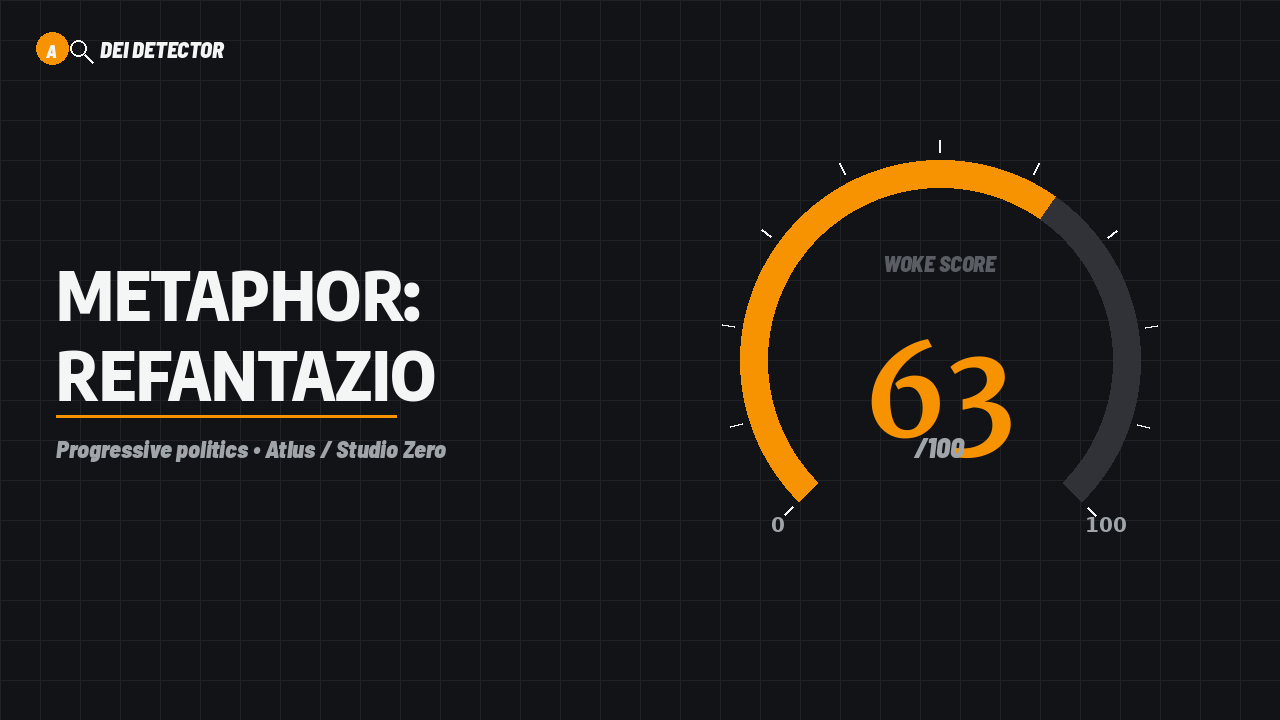
Woke Score graphic
This is the standing page for Metaphor: ReFantazio. New evidence gets merged here; the URL stays fixed.
Confirmed: politics on purpose
Director Katsura Hashino (Studio Zero, Atlus) has said repeatedly that Metaphor was built so fantasy would make players think about the real world, not escape it. Coverage of his interviews (Rolling Stone, Meristation / AS, WIRED) documents intentional themes of:
- Racism / tribe discrimination (the protagonist’s Elda tribe is treated as unholy)
- Class and caste inequality
- Xenophobia and exploitation of migrant / minority labour allegories
- Authoritarianism, religious manipulation, and populist electoral theatre
- A protagonist platform centred on a society where everyone is equal and has a fair chance — including social-safety-net reasoning when rivals punish the unable-to-work
That is not accidental flavour text. Progressive press framed the game as a progressive / democratic fable (Washington Post, Rolling Stone, WIRED). Treat that as confirmation of authorial progressive intent, not as proof of Western HR DEI checkboxes.
Weak / absent: Western DEI packaging
Evidence cuts the other way on packaging:
- No pronouns menu or identity-settings activism as a marketed feature
- No same-sex romance system as a sellable “representation” pillar; relationship content is limited and largely heterosexual-coded (PC Gamer / Kotaku coverage of bonds vs romance)
- Some progressive critics even attacked the game as “painfully cishet” for not centering queer identity alongside its race/class politics (Uppercut)
So: equality / anti-racism allegory = strong. Pronouns / queer HR packaging = not the vector. That split is why this is a mid-high score, not a 90+.
What this is not
- Not a remake that scrubbed older “problematic” fanservice for modern politics (cf. Persona remake watch pages)
- Not a localisation that rewrote clear M/F romance into they/them as the headline controversy
- Not a regional soft-build story — the released JP/EN product is the political game Hashino described
DEI Detector scorecard
| Signal | Present? |
|---|---|
| Authorial progressive equality / anti-racism agenda | Strong (Hashino interviews + main plot) |
| Progressive press celebrating it as progressive / “woke” | Strong |
| Institutions / democracy / social-safety-net messaging | Strong |
| Pronouns menu / Western HR-checklist DEI UI | Absent / not the vector |
| Queer romance as primary marketing or systems pillar | Weak / largely absent (some left critics complain) |
| Feminine / sexual censorship vs prior version | N/A (new IP, not a sanitised remake) |
| Activist mistranslation as primary controversy | Not established |
Recommendation
Play it knowing the politics are the product: an earnest equality / anti-discrimination fantasy election RPG. If your objection is specifically Western DEI packaging (pronouns, pride campaigns, localisation activism), Metaphor is a weaker match than remakes that scrub dialogue and imagery. If your objection is progressive equality messaging by design, this sits higher on the meter — and that is by the director’s own stated intent.
Sources include Hashino interviews and coverage via Rolling Stone, Meristation / AS, WIRED, Washington Post; romance / representation notes via PC Gamer, Kotaku, and Uppercut. Claims marked confirmed are tied to those public statements or widely reported plot/theme analysis; packaging absences are noted as such, not fabricated.