Persona 3 Reload
Verdict: Persona 3 Reload is mostly a faithful remake with one clear, confirmed piece of modern-sensibility sanitation: the Yakushima beach gag about a trans woman was rewritten in both Japanese and English. Fanservice, the hot-spring peeping gag, bikinis and the ESRB M rating are still there, and the English script moved closer to the Japanese, not toward inclusive-language activism. This is a light scrub, not an agenda rewrite.
Woke Score: 34/100. The beach rewrite is real and it applies worldwide, and Atlus also toned down “divisive” lines in Episode Aigis. There’s no documented feminine or sexual censorship of the cast, no pronoun or queer-representation packaging, and no activist localisation.
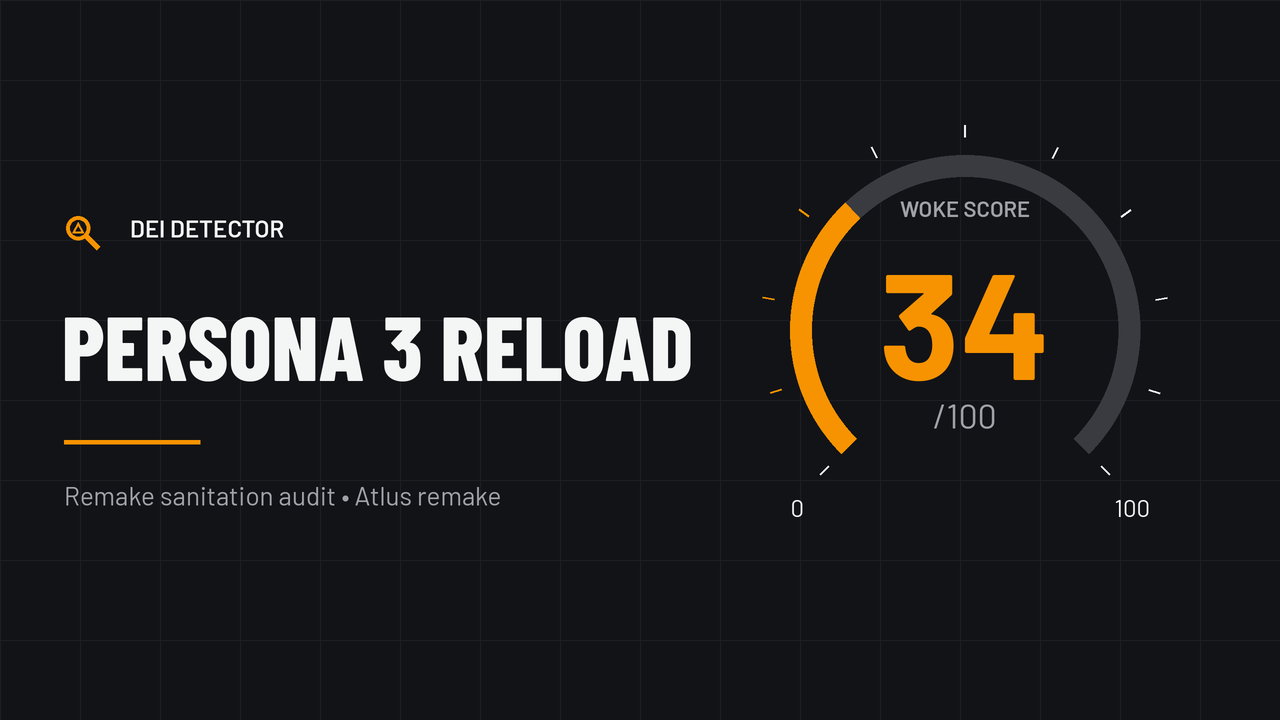
Woke Score graphic
This is the standing page for Persona 3 Reload (and its Episode Aigis: The Answer DLC). New evidence gets merged here; the URL stays fixed. Sibling Atlus pages: Persona 4 Revival and Metaphor: ReFantazio.
Confirmed: the beach “Operation Babe Hunt” twist was rewritten
In every earlier version (PS2 Persona 3, FES, Portable), Junpei drags Akihiko and the protagonist into picking up girls on Yakushima. Their last target, “Beautiful Lady” (“Pretty Lady” in Portable), is about to leave with one of them when Akihiko spots stubble on her chin. She says she “missed a spot,” her name tag turns into “Beautiful Lady?”, Junpei yells “She’s a he!?”, and the boys run off.
In Reload the setup is kept and Junpei is as horny as ever. The punchline is new: she turns out to be a conspiracy theorist who says the sun was swapped for an artificial one in the 1980s, tries to sell them “special” sunscreen for ¥300,000, and becomes “Delusional Lady.” The boys still run away.
- Both languages: Kotaku had the Japanese audio independently translated and confirmed the Japanese version plays the same way. This isn’t an English-only localisation edit like the ones in Persona 5 Royal. Digital Spy and IGN verified the new scene too.
- Atlus’s stated reason: Atlus didn’t comment on this scene specifically. General producer Kazuhisa Wada told PC Gamer the team was “extremely careful about the areas to be changed and how to adjust them” and aimed to “give it a fresh rewrite of the present.” PC Gamer’s own summary says beach scenes “criticized for sexism and transphobia were toned down.”
- How we score it: removing a trope that critics called “problematic” from the Japanese master script for a modern audience is the same remake sanitation we flag on the Persona 4 Revival watch page. It’s one throwaway scene, though, and the replacement doesn’t add a representation message. It just deletes the joke.
- Ruled out: some outlets blamed Western localisers “for global standards” (Sankaku Complex). That’s speculation. The change is in the Japanese script as well, so it’s a decision by Atlus Japan, not proof of activist translators.
Confirmed: Episode Aigis “divisive” lines adjusted
Wada told TheGamer the team “looked back at the scenario and analyzed the various opinions of the fans at the time and picked out the parts of the scenario outside of the main plot that were divisive at the time,” and made “delicate adjustments” so the characters’ “emotional premise” comes across. In Persona Magazine (translated by Persona Central) he said the premise and ending are untouched, “preserving it as historical fact.”
Fan side-by-side comparisons of the DLC mostly point to Yukari’s grief scenes. Her physical grab for Aigis’s key and some of her harsher lines in the SEES standoff were softened. That’s softer, gentler character writing, but it isn’t DEI messaging and it isn’t sexual censorship. It adds a little to the “sanitised remake” column and nothing to the agenda column.
Checked and not confirmed (or ruled out)
| Talking point | Finding |
|---|---|
| Female protagonist (FeMC) from Portable cut for politics | Ruled out. Wada (Persona Magazine / Persona Central, TheGamer, Game Informer / IGN) says she would have cost “two to three times” as much as Episode Aigis to build and couldn’t easily be outsourced. That’s a budget reason, not an ideological one. |
| Yukari / Mitsuru models “censored” (skirts, shading) | Ruled out. A Steam comparison of the FES model textures shows the old dark areas under the skirts were baked-in shadows. Reload just renders them in-engine. |
| Yukari shower scene camera less lingering | Reported by fans, not proven. Reddit and the Censorship Wiki say the shot no longer dwells on her midriff and legs. It’s a few seconds long in every version, and Reload re-shot every cutscene in Unreal Engine. No press or developer confirmation of intent, so we don’t score it. |
| Hermit (Maya) link reworked | Not substantively. Same online-game setup, same teacher-with-a-crush-on-a-student twist. The portrait is a new homage to SMT’s Heroine and the script is lightly revised. |
| Kenji’s teacher romance removed | Ruled out. The Magician link still has Kenji “dating” Ms. Kanou until she leaves to marry her fiancé. |
| Bebe link sanitised | Localisation polish only. Bebe now speaks clean English with some French and samurai-style Japanese instead of broken English. The story and characterisation are unchanged. That’s a readability choice, not inclusive-language injection. |
| Other gay-panic / “Junpei-type” jokes scrubbed | No documented cases beyond the beach scene. The Kyoto hot-spring peeping plus girls’ “execution” gag is still in (now as a stealth minigame where getting caught is optional), and so is Operation Babe Hunt itself. |
| Ghost-hunt arm-grab, weight-joke and “good-looking girls” lines removed | Unverified. These come from the Censorship Wiki without solid before/after sourcing. |
Fanservice, costumes and ratings
The feminine presentation is mostly intact:
- Unlockable swimsuits (Yukari’s pink bikini, Mitsuru’s “elegant bikini”), maid outfits from Elizabeth’s requests, Yukari’s “battle panties” and Mitsuru’s “sexy armor” all come back as in-game costumes (GameFAQs / Game Rant costume lists). The paid DLC costumes (P4G Yasogami, P5R Shujin / Phantom Thieves, Velvet set) are crossover outfits and don’t replace anything.
- Ratings: ESRB M (Blood, Partial Nudity, Sexual Themes, Strong Language, Violence; the listing mentions “female demons with partially exposed breasts and buttocks”), PEGI 16, CERO C (15+) in Japan, and USK 16. That’s still an adult rating, not a cleaned-up teen build.
- Romance was modernised: dating is now optional, turning a girl down doesn’t penalise her link, and the old jealousy mechanic is gone (Push Square, Megami Tensei Wiki). That’s a design change, not a political one, and it isn’t scored as censorship.
Localisation
Atlus West’s new script mostly moves toward the Japanese: characters go by surnames, shops use their Japanese names (Mayoido Antiques, Game Parade), the protagonist narrates in first person, and some jokes were re-translated to match the Japanese transcript (Megami Tensei Wiki comparison). We found no documented gender-neutral or inclusive-language injection and no public translator-activism controversy. Fans complain the new script feels flatter and more explanatory, and that’s the extent of it.
Marketing, cast and corporate
- Western trailers vs the game: some early English trailers swapped out Evoker “gun to the head” shots and darkened blood pools, and one trailer cut a Takaya line. That was violence and self-harm sensitivity in marketing only. In the game, the Evokers are unchanged.
- English recast: almost the whole English cast was replaced, and most of the old SEES actors came back in cameo roles. Atlus didn’t give a diversity or DEI reason, so this isn’t scored.
- Sega corporate DEI branding: it wasn’t part of how Reload was marketed. Not material.
DEI Detector scorecard
| Signal | Present? |
|---|---|
| Rewrite of a “problematic” trans-panic joke for modern sensibilities | Strong (confirmed, JP + EN) |
| Softening of “divisive” lines in Episode Aigis | Moderate (producer-confirmed intent, not DEI-themed) |
| Sexual / feminine censorship of the female cast | Weak (unverified shower-camera claim; costumes and M rating intact) |
| Woke or inclusive-language localisation | Not established (script moved closer to the Japanese) |
| FeMC cut for ideological reasons | Ruled out (cost) |
| Pronouns menu, queer-representation packaging, DEI marketing | Absent |
| Regional-only censorship | No. The one story change is universal; only Western trailers were toned down |
Recommendation
Cleanest way to play:
- Persona 3 FES (PS2, and PS3 as a PS2 Classic where it’s available) has the original story with the uncut beach scene plus the original The Answer epilogue.
- Persona 3 Portable (PSP, or the 2023 remaster on PC / PS4 / Switch / Xbox) has the female protagonist route and keeps the stubble reveal. Heads-up: Portable’s English already softened Junpei’s line to “This can’t be happening.” We found no report of the 2023 remaster changing the scene.
- Persona 3 Reload is the best-looking and most playable version, and apart from the beach punchline and the Episode Aigis tweaks it’s still Persona 3. Every Reload region has the same story content, so there’s no “uncensored region” of Reload to import.
Compared with the site’s other Atlus pages, Reload is much less woke than Metaphor: ReFantazio (progressive politics by design) and shows less confirmed sanitation than Persona 4 Revival (several producer-confirmed “world we live in now” edits plus a scrub of Shadow Kanji imagery). Reload is the lighter first step in that pattern.
Sources: Kotaku (Kenneth Shepard, 30 Jan 2024, with an independent JP translation), IGN, Digital Spy, TheGamer and GamesHub on the beach scene; PC Gamer interview with Kazuhisa Wada (6 Feb 2024); TheGamer Episode Aigis interview with Wada (10 Sep 2024); Persona Central’s translation of the Persona Magazine Wada / Hashizume interview (22 Mar 2024); GameSpot, GamesRadar+ and IGN / Game Informer on the FeMC; Siliconera interview with Niitsuma / Yamaguchi; the ESRB rating summary; Push Square’s change list; Megami Tensei Wiki’s change log; the Steam community FES model comparison; RPG Site and Game Rant social-link guides; GameFAQs / Game Rant costume lists. Anything marked “confirmed” is tied to on-screen footage or developer statements, and anything else is labelled as rumour or unverified.