
Yen Press
Verdict: Yen Press is a major English manga / light-novel / manhwa publisher (Yen Press LLC), not a single-title product. Score the publisher brand: Hachette Book Group minority ownership brings documented corporate DEI (“Changing the Story”) packaging; Yen’s own public localisation brief emphasises accuracy and author intent, and the catalogue still ships mature fanservice (e.g. Chained Soldier 18+, Interspecies Reviewers, High School DxD). Documented flashpoints are mostly title marketing (Slave → Chained Soldier) and ordinary translation mistakes, not a Seven Seas–style admitted “respectful and inclusive” gender rewrite. Score moderate, not extreme.
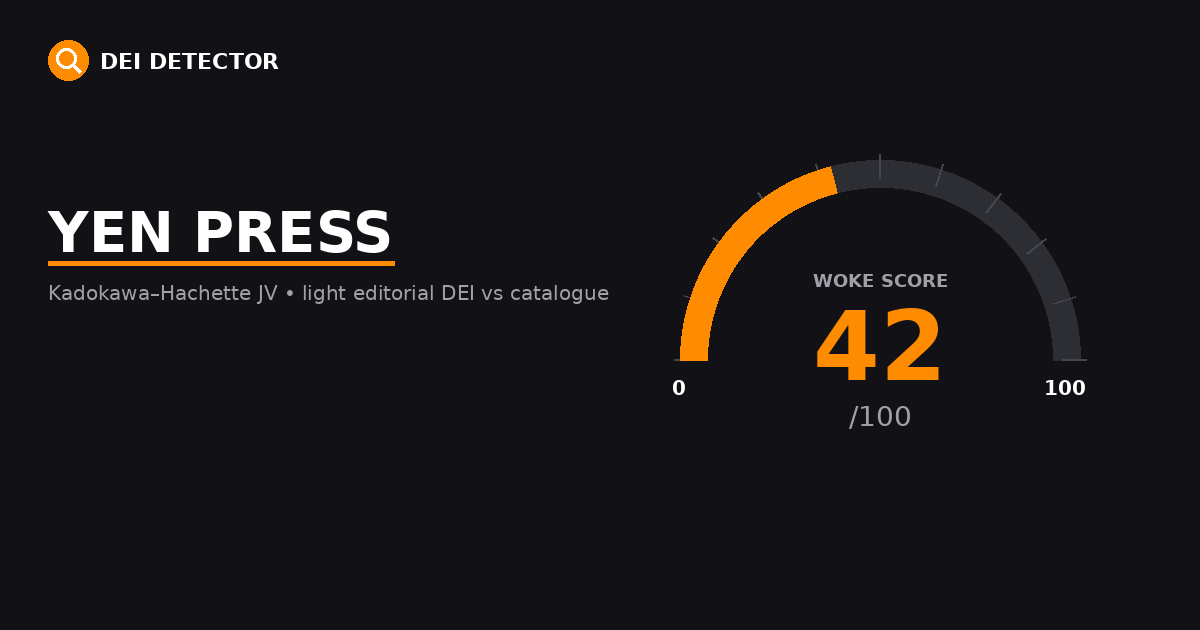
Woke Score: 42/100 — parent-company progressive branding + occasional retail/title sanitisation raise the brand score; heavily offset because Yen has not been caught in a comparable pattern of intentional inclusive mistranslation, publishes uncensored-leaning mature art on multiple titles, and states accuracy/author-intent as house policy.
Woke Score graphic
This is the standing brand page for Yen Press (slug yen-press). New evidence gets merged here; the URL stays fixed. Do not flatten every licensed series into this score — score publisher editorial / marketing / ownership signals, then link out to title pages when needed (e.g. Chained Soldier manga).
What they publish
Yen Press ships manga, light novels (Yen On), Korean comics (Ize Press), middle-grade (JY), audiobooks (Yen Audio), and some OEL / Western graphic novels. Public about page: catalogue of 3,000+ titles; World English rights for much of the list. High-profile JP lines include Sword Art Online, That Time I Got Reincarnated as a Slime, Overlord, Fruits Basket, Black Butler, Delicious in Dungeon, Oshi no Ko, Goblin Slayer, and many Kadokawa properties — plus mature/ecchi picks that undercut a “total Western scrub” caricature.
Ownership & positioning
- Joint venture (2016): Kadokawa Corporation 51% / Hachette Book Group 49% (Yen Press LLC). Founded 2006 as an HBG imprint by Kurt Hassler (with Rich Johnson); spun into the JV so Kadokawa holds majority.
- Distribution: Hachette Book Group (U.S.); Diamond internationally (per Wikipedia / trade notes).
- Yen’s own about copy: availability/appreciation of comics; “wide spectrum of voices”; no standalone Yen Press DEI / EDI mission page found in sources used here — contrast with HBG’s public DEI pillar.
- Hachette Book Group “Changing the Story”: ongoing DEI program with annual public updates, DEI Director, ERGs (including Pride), diversity hiring/acquisition metrics, and CEO language about aligning publishing with “diverse perspectives” and historically underserved readers (HBG Changing the Story; April 2025/2026 DEI updates). Material for a brand score because HBG is a 49% owner and fulfills Yen’s store/fulfillment path — not proof every Yen volume is a progressive rewrite.
Documented localisation & censorship patterns
Stated house policy (primary)
Yen’s translator FAQ: ideal work prioritises “accuracy and preservation of author intent,” plus readable localisation so jokes/horror/romance land. Honorifics generally dropped in prose novels. That is a fidelity brief, not an “inclusive language” brief.
Confirmed / widely reported flashpoints
| Signal | What happened | Score weight |
|---|---|---|
| Mato Seihei no Slave → Chained Soldier | Yen Press English title drops “Slave” for retail/marketing naming | Present — title sanitisation, not proven plot DEI rewrite; Yen volumes still reported as matching JP tankōbon body art (see manga page) |
| Pronoun / gender mix-ups (Tensei Slime dragonnewts; Dungeon Meshi Mickbell/Thistle-type cases in fan docs) | Reader reports of wrong he/she when JP was ambiguous or later clarified | Treat as error / ambiguity, not established intentional they/them activism unless primary editor statements appear |
| Soul Eater Crona gender | Historical EN pronoun choices on an intentionally ambiguous character | Ambiguity handling — not scored as modern DEI packaging without fresh primary quotes |
| Mahouka onii-sama → name address early vols | Honorific/relationship localisation that broke later plot payoff; later vols adjusted | Localisation taste / consistency — weak DEI signal |
What is not established for Yen Press (do not invent)
- No ANN/primary-equivalent admission that Yen intentionally rewrote a masculine cross-dresser into a transgender woman “to keep language respectful and inclusive” (that pattern belongs to Seven Seas — see /blog/seven-seas/).
- No credible headline that Yen systematically body-scrubs mature manga vs JP tankōbon as house policy; Chained Soldier reader reports go the other way.
- Accessibility statement on yenpress.com is web accessibility, not a content DEI manifesto.
DEI / progressive branding
- Yen corporate: thin public DEI packaging beyond “spectrum of voices” about-page language.
- Hachette parent (49%): thick — Changing the Story, DEI Director Sara Munjack, annual representation reports, Pride ERG, acquisition diversity targets. Score ownership adjacency, and say so.
- Catalogue curation: large share of mainstream shōnen/seinen/isekai + yuri/BL-adjacent titles; publishing queer stories ≠ injecting inclusive localisation. Score localisation behaviour, not “ships yuri.”
Notable series examples (publisher-level)
- Fanservice / mature kept in English product path: Chained Soldier (18+ M; title rename only as main flashpoint), Interspecies Reviewers, High School DxD, Triage X, Breasts Are My Favorite Things in the World! — catalogue evidence against a total Western feminine scrub.
- Big commercial anchors: SAO, Slime, Overlord, Delicious in Dungeon — fan localisation gripes exist; DEI rewrite is not the headline vector in primary-source coverage used here.
- Compare carefully: Viz (Ayakashi Triangle chapter soft-censor history) and Seven Seas (documented inclusive mistranslation + MT/COTE soft-edits) are clearer localisation-controversy brands than Yen on present evidence.
Cleaner alternatives / competing editions
- Prefer JP tankōbon / bunko when disputing a specific line.
- For titles Yen shares ecosystem with, check whether another EN licensor ever held the same property (rare for current Yen exclusives).
- Title-level pages beat brand vibes — e.g. Chained Soldier (manga).
DEI Detector scorecard
| Signal | Present? |
|---|---|
| Standalone Yen Press DEI / EDI mission as content policy | Weak / absent |
| Hachette “Changing the Story” progressive branding (49% owner) | Strong — labelled ownership |
| Stated accuracy / author-intent translation policy | Strong (FAQ) |
| Intentional inclusive gender rewrite (admitted) | Not established |
| Title / marketing sanitisation (Slave → Chained Soldier) | Present |
| Systematic body-scrub vs JP volumes as house policy | Not established |
| Mature / ecchi catalogue still shipping | Strong |
| Pronoun errors / ambiguity mishandling | Partial — treat as errors unless proven agenda |
Score rationale
42 sits in the low-to-mid band: parent DEI infrastructure is real and ongoing, and retail title softening counts under the detector’s localisation/marketing lens — but Yen lacks Seven Seas’ on-record “inclusive” intentional gender overwrite and has a catalogue that still prints hot mature material. If future volumes ship documented progressive dialogue injection or body scrub with page evidence, raise the score; if Yen publishes an explicit fidelity audit trail after controversies, lower it.
Recommendation
Buy Yen for catalogue breadth and many faithful-enough mature releases; watch Hachette corporate DEI as ownership context, not as automatic proof each volume is rewritten. For gender/identity localisation patterns, Seven Seas has the clearer primary-source paper trail. Update this page if Yen issues a comparable “respectful and inclusive” admission or if HBG/Yen publish a Yen-specific content DEI style guide.
Open to update
- Any Yen-specific sensitivity / DEI style guide if published
- Page-diff proof of body scrub vs JP on a flagship mature title
- Official statements on Chained Soldier naming rationale beyond marketing speculation
- Material change in Kadokawa/Hachette ownership split or editorial control
Sources include Yen Press About and translator FAQ (accuracy / author intent); Yen Press / HBG–Kadokawa JV announcement; Wikipedia Yen Press ownership notes; Hachette Book Group Changing the Story and April DEI updates; Bounding Into Comics on Chained Soldier title rename; ANN / fan documentation on pronoun ambiguity cases summarised as errors; cross-check against Seven Seas primary controversies on the sister brand page. No invented Yen “inclusive rewrite” admissions.