Seven Seas Entertainment
Verdict: Seven Seas Entertainment is a major English manga / light-novel / danmei / webtoon publisher, scored as a brand. Unlike thin vibes claims, Seven Seas has a primary-source paper trail: admitted “respectful and inclusive” English that differed from author intent on I Think I Turned My Childhood Friend Into a Girl, plus heavy-handed editorial omissions/rewrites on Mushoku Tensei and Classroom of the Elite (ANN-confirmed; later revisions promised). Offset hard with Ghost Ship (mature ecchi/uncensored-leaning imprint: To Love Ru, World’s End Harem, Yuuna, etc.) and later course-corrections. Score high-moderate, not 90+.
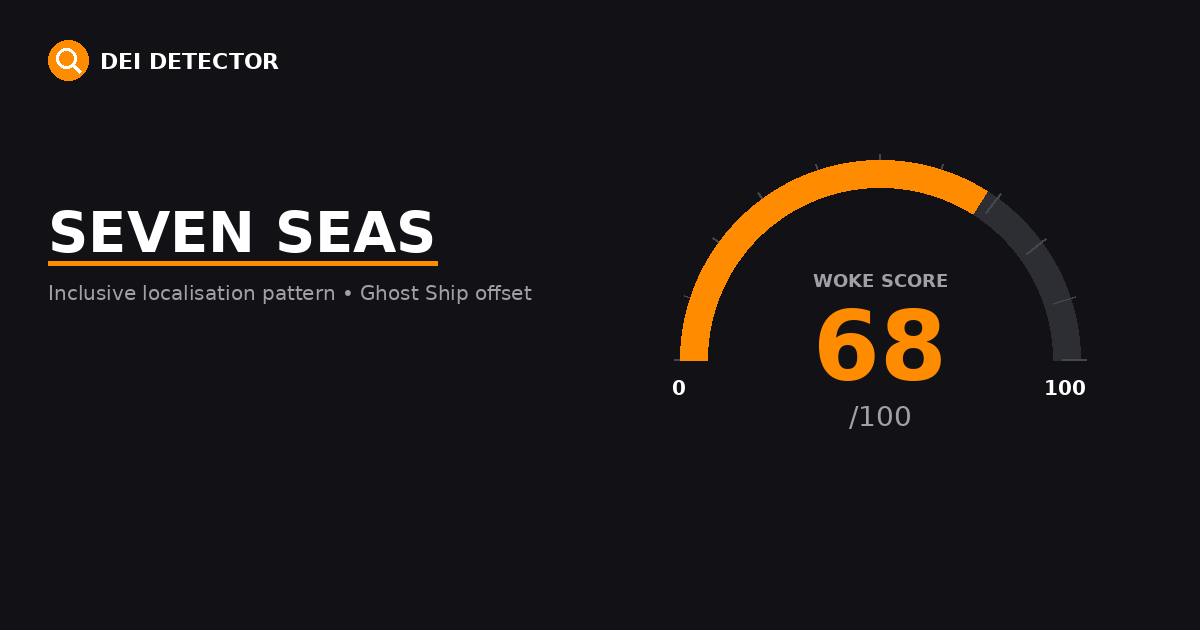
Woke Score: 68/100 — intentional inclusive gender framing + moralising soft-edits of sexual-assault language are core detector hits; reduced from the 80s because Seven Seas revised under pressure, still publishes extreme mature catalogue via Ghost Ship/Steamship, and queer licensing alone is not scored as woke localisation.
Woke Score graphic
This is the standing brand page for Seven Seas Entertainment (slug seven-seas). New evidence gets merged here; the URL stays fixed. Title-level disputes belong on title pages; this page tracks house editorial patterns.
What they publish
Seven Seas licenses manga, light novels (Airship), Ghost Ship mature manga, Steamship romance, Siren audiobooks, Chinese danmei, Korean webtoons/manhwa, and some OEL/Hiveworks print. High-profile lines include Mushoku Tensei, Classroom of the Elite, Made in Abyss, The Ancient Magus’ Bride, Monster Musume, Bloom Into You, I’m in Love with the Villainess, MXTX danmei (SVSSS, MDZS, TGCF), plus Ghost Ship ecchi anchors.
Ownership & positioning (verify carefully)
- Founded 2004 by Jason DeAngelis in Los Angeles; long marketed as the largest independently owned EN manga publisher.
- Distribution ≠ ownership: From July 2021, print is distributed worldwide by Penguin Random House Publisher Services (PRHPS) — a sales/distribution agreement, not a historical PRH acquisition of the company (Seven Seas / PRHPS 2020 announcement).
- Acquisition (2026-03-01): Media Do International (MEDIA DO Group / Japanese digital distributor parentage) entered a definitive agreement to acquire Seven Seas for a reported US$80M; leadership/editorial direction and PRHPS distribution said to continue (ANN press coverage; Wikipedia parent note). Score current parent = Media Do International; do not call Seven Seas “owned by Penguin Random House.”
- Public about copy emphasises licensing breadth and fan-minded publishing — no standalone Seven Seas DEI mission page located in sources used here; behaviour is scored from editorial incidents, not missing boilerplate.
Documented localisation & censorship patterns
1) I Think I Turned My Childhood Friend Into a Girl (2022) — intentional inclusive rewrite
Fans documented Vol. 1 English framing Hiura (feminine male / otokonoko BL context in JP) as a trans woman, altering gender language and story intent. Seven Seas’ official statement (July 2022, archived via Twitter / series page):
subject matter is delicate… “we took every effort to keep the language respectful and inclusive.” After talking to rights holders, “our edition differs in certain details from the author’s intent.” They would revise Vol. 1 reprints and use a collaborative team for future volumes.
That is a detector direct hit: intentional inclusive localisation overriding authorial gender presentation — later walked back. Revised Vol. 1 noted on the Seven Seas book page (Feb 2023 reprint path).
2) Mushoku Tensei & Classroom of the Elite (2021) — heavy-handed soft-edits
ANN 2021-02-17 (Kim Morrissy; ANN personally confirmed MT examples):
- COTE Vol. 7: large omissions of prose/dialogue; Seven Seas admitted “heavy-handed editorial approach” and re-edited print/digital.
- Mushoku Tensei Vols. 1–2 examples: sleeping-girl molestation beat rewritten into adjusting a shirt “so she wouldn’t catch a cold”; Paul/Lilia rape references softened to “cheater and womanizer” / force language removed.
- Translators Alyssa Orton-Niioka and Paul Cuneo stated they were blindsided — changes were editorial, after translation, against a fidelity preference.
Seven Seas framed localisation as judgement calls balancing accuracy with “commercially viable” polished English — then promised re-evaluation/adjustments. Fan reports later tracked uneven completeness of MT revisions — treat specific reprint diffs as open verification, not folklore.
3) I’m in Love with the Villainess (2021) — editorial cuts (mixed politics)
Vol. 1 omitted inner-monologue material about Japanese media / internalized homophobia tropes. Seven Seas told ANN cuts happened in editorial and they would restore eBook + future printings after changing edit process so “important lines are not lost.” Directionally opposite to anti-LGBT scrub — still heavy undocumented editorial that angered the book’s queer readership. Counts as process failure / content gatekeeping, scored lighter than the inclusive gender overwrite but part of the same 2021 pattern.
DEI / progressive branding
- No thick public Seven Seas DEI annual report akin to Hachette’s Changing the Story found here.
- Catalogue: heavy investment in yuri, BL, danmei, queer webtoons — score as market positioning, not automatic “woke localisation.” Detector care: shipping Bloom Into You ≠ rewriting Hiura’s gender.
- Labor (2022): United Workers of the Seven Seas / CWA organising; voluntary recognition after card check (ANN). Labor rights ≠ DEI content score; mention only as corporate context.
- Ghost Ship / Steamship: explicit mature and sexy-romance imprints — major offset against a “Seven Seas censors all fanservice” claim.
Notable series examples
| Title | Issue | Outcome |
|---|---|---|
| I Think I Turned My Childhood Friend Into a Girl | Inclusive gender overwrite vs JP otokonoko/BL intent | Admitted; revised reprints / future vols |
| Mushoku Tensei LN | Softened SA / rape language; other omissions | Re-evaluation + partial revision campaign |
| Classroom of the Elite Vol. 7 | Heavy omissions | Re-edited reissue |
| I’m in Love with the Villainess Vol. 1 | Cut LGBTQ cultural monologue | Restored after complaint |
| Ghost Ship line (To Love Ru, WEH, Yuuna, etc.) | Mature ecchi kept as imprint strategy | Offset |
Cleaner alternatives / competing editions
- Prefer JP light novels / manga when EN soft-edits are the objection; check whether a given SS volume is a post-revision printing.
- For MT anime vs LN: anime sometimes restored beats the early EN LN softened — name the medium when comparing.
- Competitor contrast: Yen Press (see /blog/yen-press/) has thinner intentional-inclusive paper trail; Viz controversies are often chapter soft-censor / ratings (different vector).
DEI Detector scorecard
| Signal | Present? |
|---|---|
| Admitted inclusive language overriding author gender intent | Strong (Childhood Friend statement) |
| Heavy editorial soft-edit of SA / “problematic” sexual content | Strong (MT; ANN-confirmed) |
| Heavy undocumented condensation/omission (COTE 7) | Strong |
| Publisher DEI annual report / EDI content manifesto | Weak / absent |
| Queer-heavy catalogue licensing | Strong — ≠ localisation rewrite by itself |
| Ghost Ship mature uncensored-leaning imprint | Strong — offset |
| Revisions after backlash | Present — lowers persistence, does not erase original hit |
| Owned by Penguin Random House | False — PRHPS = distribution; parent Media Do International (2026 deal) |
Score rationale
68 reflects repeated, documented editorial interventions that match detector rules (inclusive mistranslation; moralising sexual-content soft-edits), with primary statements — not forum mythology. It is not 85–100 because Seven Seas revised under fire, still runs Ghost Ship, and licensing queer romance is not scored as DEI localisation. Raise if a new title ships an unrevised inclusive overwrite; lower if multi-year audit shows clean fidelity as new house normal.
Recommendation
Treat early-print Seven Seas prose of flagged titles as suspect until you confirm revision status; prefer JP or verified revised EN. Use Ghost Ship when the complaint is “EN manga never ships ecchi” — that complaint is wrong for this publisher. For brand-level inclusive localisation risk, Seven Seas currently outranks Yen Press on primary evidence.
Open to update
- Post–Media Do editorial policy memos (fidelity vs inclusive style)
- Line-by-line audits of which MT volumes remain soft vs fully restored
- Any new Childhood Friend–class gender overwrite without prompt revision
- Clarification if PRHPS contract terms ever add content standards (none public here)
Sources include ANN 2021-02-17 (Morrissy) on MT/COTE with publisher statement + translator tweets; ANN / Wikipedia on ILTV omissions; Seven Seas official Childhood Friend statement (Jul 2022) and series reprint notes; Niche Gamer / Bounding Into Comics contemporaneous coverage; Seven Seas Ghost Ship launch (2017); PRHPS distribution announcement (2020); Media Do International acquisition press (2026-03-01); Wikipedia Seven Seas ownership/controversies summary cross-checked against primary statements. No fabricated scandals; revision completeness for every MT volume left as open verification.