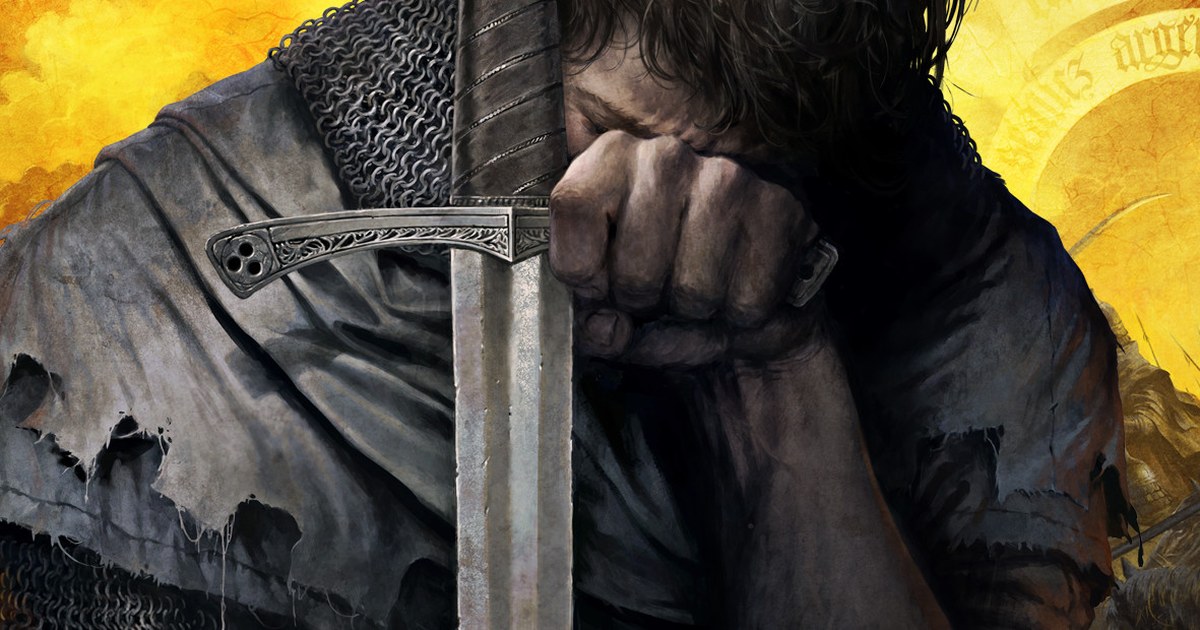
Kingdom Come: Deliverance
Verdict: Kingdom Come: Deliverance is a first-person RPG about Henry, a blacksmith’s son in 1403 Bohemia, and it’s about as far from a DEI project as a big Western game gets. The cast is the rural Bohemia Warhorse researched: Czechs, Germans, some people of Jewish descent, and the Turkic Cumans as the invading enemy. Women are wives, healers, nuns, bathmaids and noblewomen of their time, and the romances are straight and optional. Nothing was added to meet a representation goal, no sensitivity or DEI consultant is credited, and nothing was patched out. What it did get was a wave of progressive press criticism in 2018 over its lack of people of colour, its women, and its creative director’s politics. That’s a green flag under our rules, but with nothing to offset it can’t take the score below zero.
Woke Score: 0/100. We found no documented DEI or woke content, consultancy, mandate or censorship in the original game or its DLC. The only censorship is the Japanese console and DMM PC release’s ratings-board edits, which are regional and don’t make the original woke.
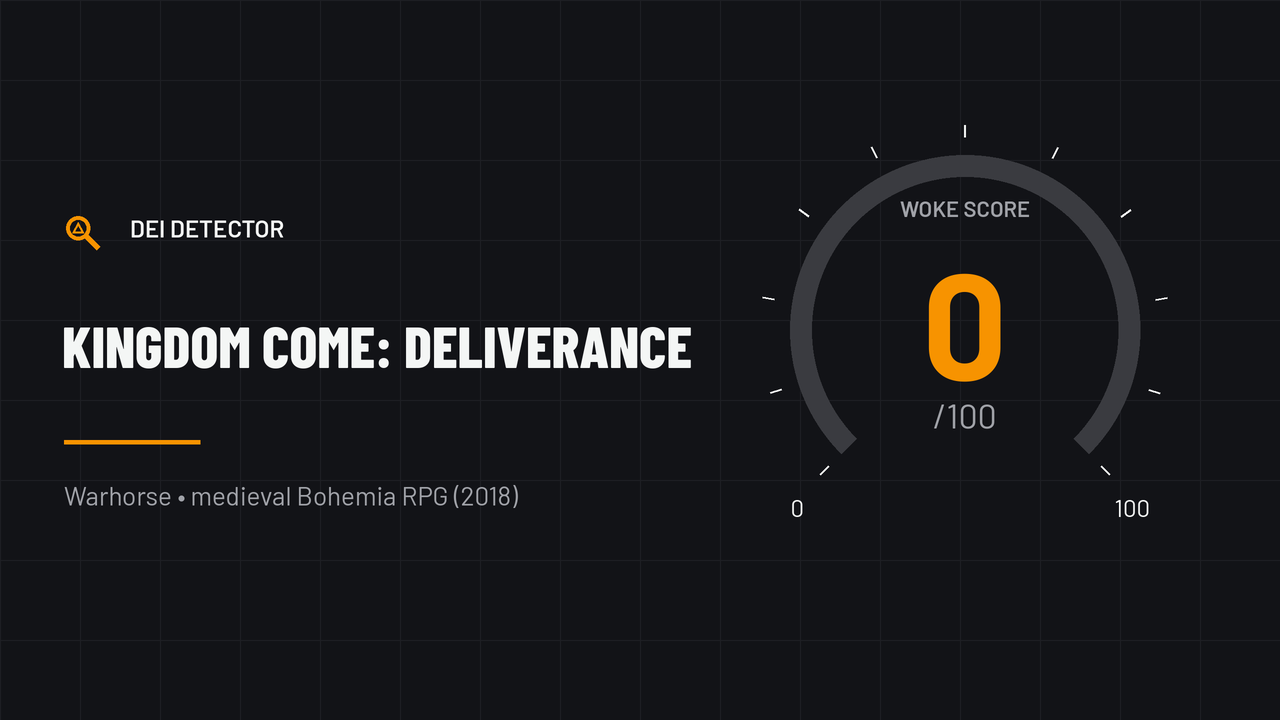
Woke Score graphic
This is the standing page for Kingdom Come: Deliverance (PC, PS4 and Xbox One, 13 Feb 2018; Switch Royal Edition 2024), including its DLC. New evidence gets merged here; the URL stays fixed. The sequel has its own page: Kingdom Come: Deliverance II.
How the score breaks down
Scored against our How we score rules:
- Story, casting and creator intent: 0. The setting is a small, rural slice of Bohemia around Rattay and Sasau, and the cast reflects Warhorse’s research into it. There are no additions made for representation, and no creator statement about representation goals. Daniel Vávra’s stated aim was historical: “I like medieval history. I like castles… I like my country,” and he wanted the game “to do what Braveheart did to Scottish culture” (Reboot Develop talk, reported by VG247). Vávra has said the first game already had gay characters (IGN, Jan 2025); they’re minor, period-framed and never pushed on the player, so they add nothing.
- A Woman’s Lot DLC (May 2019): 0. It delivers a Kickstarter stretch goal: a playable Theresa, showing her escape from the Skalitz massacre, plus a separate story for Sister Johanka, the nun who runs the Rattay hospital. Reviewers read it as a woman’s-eye view of medieval life rather than a message: women’s options are limited by the period, and they survive and act within it. Tabletowo called it a DLC “with a pinch of feminism”. It isn’t girlboss writing, so it scores nothing (see rule E).
- Consultancy check (rule A): none found. The credits list History Advisors who are Czech academics (Petr Čornej, Jan Klípa, Robert Novotný, Jan Royt, Petr Sommer and others), the Institute of the History of Charles University, and living-history groups, plus swordfighting, AI and script consultants (MobyGames). No DEI, inclusion, sensitivity or cultural consultancy is credited. The game isn’t in Sweet Baby Inc.’s documented gameography or on the “Sweet Baby Inc detected” Steam curator’s list, and we found no internal inclusion or sensitivity team.
- Track-record rule (rule B): not applied. Warhorse had no DEI or censorship record before this game, and we found no documented mandate from Deep Silver (then Koch Media) affecting it.
- Remake rule (rule C): doesn’t apply. It’s an original game. The 2019 Royal Edition and the 2024 Switch port changed nothing in the content; the Switch changes are technical only (Digital Foundry).
- Rule D (green flag): documented, worth about −10, but there’s nothing for it to offset. The press attacks were real and wide. Eurogamer’s review called the lack of people of colour “a big problem” and quoted a historian arguing there should have been Black characters, then linked it to Vávra’s GamerGate support and a Burzum T-shirt. Polygon wrote that “women seem to have only three functions… two-dimensional sex objects, fetch water from the river, or do needlepoint”. Rock Paper Shotgun said female characters “typically fall into the categories of maidenly love interest, prostitute or surrogate mother”. Metro’s GameCentral said female characters are “constantly sidelined and/or treated as chattel”. Academic critiques followed, notably Helen Young’s chapter “Race and historical authenticity: Kingdom Come: Deliverance”. Green flags only lower a score, and there are no red flags here to lower, so it’s listed, not counted.
- Rule E (feminism): neutral, not scored. Theresa is brave, capable and a traditional, feminine romantic lead; Lady Stephanie and Johanka are strong in period-appropriate ways. Men aren’t written as fools for being men. That’s the traditional kind of strong women our rules treat as neutral.
Total: 0 + 0 + 0 = 0.
Confirmed findings
- Ethnic make-up: mostly Czechs and Germans, with Cumans (a Turkic steppe people serving Sigismund’s Hungarian army) as the enemy. Executive producer Martin Klíma said in Warhorse’s statement to GameStar (Jan 2018) that claims the studio removed non-white people to build an “Aryan” world were “not true”. He said that after years of research they found no proof either way about dark-skinned people in the area, and that the game tells the story of ordinary people in “a very small part of medieval Europe”, not Prague or Rome.
- Vávra’s own line: in 2015 he tweeted “There were no black people in medieval Bohemia. Period.” He apologised in the 2018 GameStar statement for careless personal communication, while rejecting the racism accusations. His statements, GamerGate support and politics drove much of the coverage; the game itself contains no racial messaging either way.
- Romance: Theresa and Lady Stephanie are the main love interests. Bathhouse visits and one-night flings are optional. The “Amorous Adventures of Bold Sir Hans Capon” DLC is a comedy side story about Hans chasing a woman.
- Female presentation: unchanged since launch in the Western versions. There’s nudity and sex, and no redesigns or cover-ups.
Checked and not confirmed (or ruled out)
| Talking point | Finding |
|---|---|
| Warhorse deleted non-white characters to make an “Aryan” game | Ruled out. Warhorse denied it (GameStar, Jan 2018), and the game includes Cumans, Germans and people of Jewish descent. |
| The game contains racist or Nazi messaging | Not found. Even Eurogamer’s critical review said it “isn’t… a hotbed of racism”. The criticism was about who’s absent, not what’s said. |
| Diversity added later by patch or DLC | Ruled out. No patch, edition or DLC added characters for representation. A Woman’s Lot was a 2014 Kickstarter promise. |
| DEI or sensitivity consultant credited | Ruled out. Only academic historians and living-history groups are credited as historical advisers. |
| Content cut in later patches or ports | Not found. The Royal Edition and Switch port keep all content. |
| Censored Western build | Not found. The only edited version is the Japanese one (see below). |
Cleanest version and regional notes
Play the standard international version: PC (Steam or GOG), Western PS4 or Xbox One, or the Switch Royal Edition, which is visually cut down but has the same content. The Japanese version (DMM Games, PS4 and PC, 2019, CERO Z) is edited to meet the ratings board: the Japanese producer, Takuya Matsumoto, told Game*Spark that two “slightly sexy scenes” are darkened and one scene with exposed organs was altered, with no quests or events removed. DMM’s notice lists the same changes (“some sexual depictions” and “exposed human internal organs”). That’s regional ratings censorship, not a woke change to the original, and it doesn’t count against the score.
DEI Detector scorecard
| Signal | Present? |
|---|---|
| Representation added to story or cast | Not found (0) |
| Creator statement on representation goals | Not found (0) |
| DEI / sensitivity consultancy credited | Not found |
| Studio or publisher DEI track record | Not found |
| Sexual / feminine censorship (Western versions) | Not found |
| Girlboss writing (rule E) | Not found (Theresa, Stephanie, Johanka are neutral) |
| Progressive press attack (rule D) | Strong (Eurogamer, Polygon, RPS, Metro, academics); nothing to offset |
| Regional censorship | Japan only (DMM, CERO Z edits) |
Open to update
This page will be revisited if:
- A sensitivity, cultural or DEI consultant, or an internal review team, turns up in credits or reporting for the first game (rule A).
- Warhorse or Vávra says anything was cut or added for representation reasons in the first game or its DLC.
Sources: Eurogamer, “Kingdom Come: Deliverance review - history is a double-edged sword” (Robert Purchese, 20 Feb 2018, archived); Polygon, “Kingdom Come: Deliverance is beautiful, but boring” (Charlie Hall, 16 Feb 2018); Rock Paper Shotgun, Kingdom Come: Deliverance review (Feb 2018); Metro GameCentral review (16 Feb 2018); Kotaku review (Luke Plunkett, 14 Mar 2018); GameStar, “Die Reaktion auf die Rassismus-Vorwürfe” (Jan 2018, statements by Daniel Vávra and Martin Klíma); VG247 on Vávra’s Reboot Develop talk; Daniel Vávra on X (23 Feb 2015); IGN on Vávra’s Jan 2025 thread; Helen Young, “Race and historical authenticity: Kingdom Come: Deliverance”, in The Middle Ages in Modern Culture (eds. Karl Alvestad and Robert Houghton, Bloomsbury); Rock Paper Shotgun and Unwinnable (Reid McCarter) on the authenticity debate; TechRaptor, Wccftech and Tabletowo reviews of A Woman’s Lot (2019); MobyGames credits (archived); Wikipedia’s Sweet Baby Inc. gameography and the “Sweet Baby Inc detected” Steam curator list (checked 26 Sep 2026); GameSpark interview with Takuya Matsumoto (18 Jul 2019) and DMM’s Japanese-version notice on the Japanese edits; Digital Foundry on the Switch port. Anything marked “confirmed” is tied to developer statements, credits or the game itself, and anything else is labelled as unverified.*