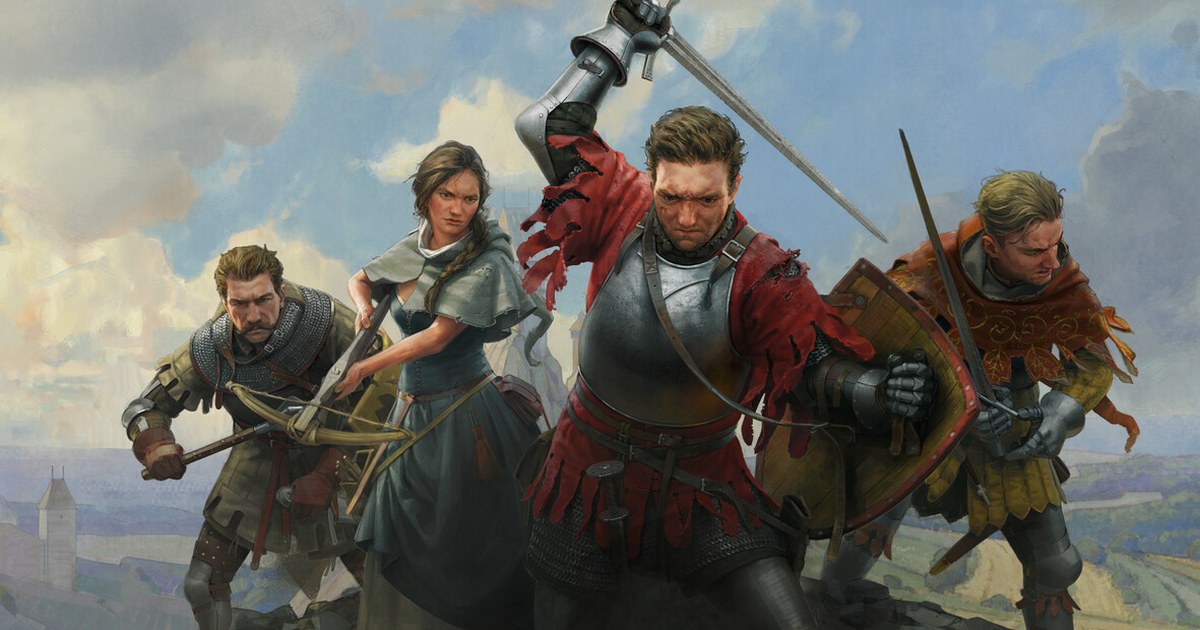
Kingdom Come: Deliverance II
Verdict: Kingdom Come: Deliverance II is a superb historical RPG, and on screen it plays much like the first game: a gritty, un-preachy 1403 Bohemia where prejudice is shown as it was, the women are traditional and the sex scenes are intact. It does add things the first game didn’t have, and Daniel Vávra admits part of the motive was to answer the 2018 criticism: Musa of Mali, a fictional Black scholar in King Sigismund’s camp, a partly invented Jewish quarter, a Roma camp, and an optional same-sex romance with Hans Capon that Vávra pushed through himself. All of it is written with period attitudes, and none of it is forced on the player. The credits also list Jewish, Roma, African and Christian “history and culture” consultants, and Vávra has said Warhorse ran the script past an adviser “for every religion, for every minority”. We looked at who they are and what they advised. They’re historians, a museum curator, a Jewish-history writer, language experts and one Roma-rights advocate, not a DEI firm, and every first-hand account describes accuracy work. That gets a “possible influence” note, not a penalty.
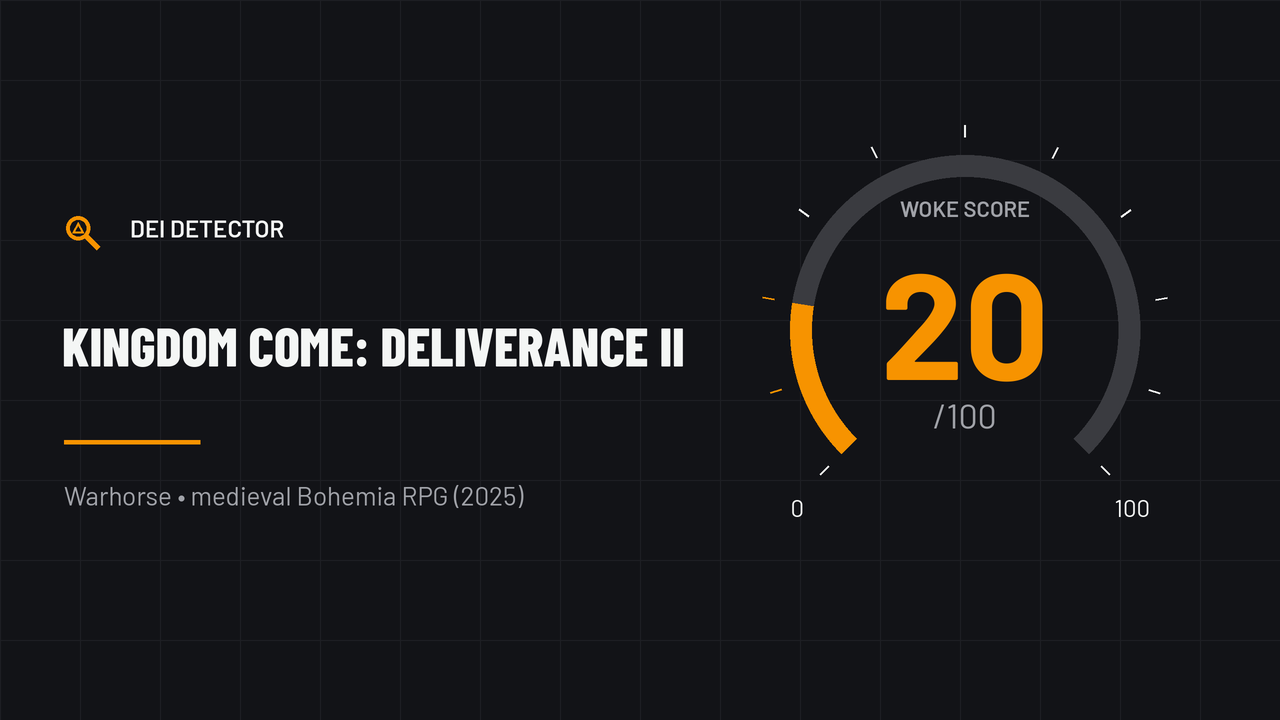
Woke Score: 20/100. Two deliberate, debated choices score: the additions made partly to answer the 2018 critics, and the creator-pushed optional gay romance. The consultants aren’t scored, because no source shows their advice pushed an agenda or removed content to avoid offence. What keeps it low: period-accurate framing, nothing forced, no DEI firm, no girlboss writing and no censorship of the Western version.
Woke Score graphic
This is the standing page for Kingdom Come: Deliverance II (PC, PS5 and Xbox Series X|S, 4 Feb 2025), including its three 2025 story expansions. New evidence gets merged here; the URL stays fixed. The first game has its own page: Kingdom Come: Deliverance.
How the score breaks down
Scored against our How we score rules:
- Representation added partly to answer the 2018 critics, +12. Musa of Mali is invented: the game’s codex says he’s a fictional mix of Mansa Musa and Ibn Battuta. The separate Jewish quarter and its synagogue are also invented; the codex admits the district “never existed” and the Kuttenberg synagogue “was not built until 1881”, though a Jewish community did live in the town. The Roma camp is plausible for 1403 but not documented locally. Vávra said on the Czech podcast Insider (Apr 2025, public part): “trošku jsem jako chtěl reflektovat nějak tu kritiku z minule”, roughly “I wanted to reflect the criticism from last time a bit, so we put in some things they acted like were completely normal… but we put them in the way they could really have been”, adding that he assumed “the people demanding it really wouldn’t like it”. That’s representation added partly in reply to progressive critics, so it counts. It isn’t higher because all of it is framed with period attitudes: Henry gawps at Musa, the townsfolk distrust him, and the Jewish storyline includes a pogrom. Warhorse CEO Martin Frývaldský calls it “a creative decision, definitely no agenda” (CzechCrunch), and Vávra says it’s there “only… to make an interesting story, and not at all to appeal to a ‘modern audience’” (X, 19 Jan 2025).
- Optional same-sex romance, creator-pushed, +8. Henry can romance Hans Capon through heart-marked choices across several main quests, ending in a kiss and a sex scene during the Suchdol siege; it’s mutually exclusive with Katherine’s farewell. Vávra: “It was my idea, my decision and my responsibility and I had to convince others to do it,” adding that Warhorse “made the gay community happy and gave them the CHOICE to be themselves” (X, 16 Apr 2026, via Kotaku and PC Gamer). It was nominated for two Gayming Awards in 2026 and won neither. It isn’t higher because it’s optional, Vávra says the characters are “perfectly aware that it was a forbidden sin”, and it wasn’t marketed. Vávra says KCD1 already had gay characters too.
- Consultancy (rule A): no DEI firm; other consultants not scored. Sweet Baby Inc. or a similar DEI or sensitivity firm isn’t involved. The credited history and culture consultants are judged on what they advised, and every first-hand account describes historical, cultural or language accuracy work (details in the consultancy section below). 0.
- Possible influence (not scored): offence-avoidance motive for the script checks. Vávra’s own framing of those checks mentions sensitivity. He said the studio self-censored in “how we depict” some things “because nowadays, when everyone is sensitive, that’s a problem”, and checked everything with advisers “so that nobody would complain that we depict someone differently than it should be”. He said “they tell you: look, don’t put this in…”. That’s enough to flag. It isn’t scored because the question he says they asked was “whether something is wrong”, the one example he starts to give is cut off mid-word (“this wasn’t yet…”, which sounds like an anachronism), and no removed content has been identified. This line adds 0.
- Track-record rule (rule B): not applied. Warhorse has no prior DEI or censorship record; the first game has neither. Plaion (Deep Silver) and Embracer have no documented DEI mandate we could tie to this game, and Vávra says the publisher never said “you did this, remove it, we don’t want it, it’s too risky”.
- Remake rule (rule C): doesn’t apply. It’s a sequel. Returning characters weren’t redesigned or toned down.
- Rule D: nothing to count. Progressive outlets mostly praised the game, including its diversity (PC Gamer’s feature on Warhorse). The attacks that did come targeted Vávra rather than the work: Rock Paper Shotgun’s “Gamergator rhetoric” feature (Jan 2025) and Kotaku’s piece on his Gayming Awards post (Apr 2026). RPS’s review did call the portrayal of women “pretty boorish” and “living stereotypes”, but that’s one paragraph in a positive review, so like similar asides on other pages it isn’t scored. The anti-woke backlash doesn’t count under rule D.
- Rule E (feminism): neutral, not scored. Katherine, Klara, Rosa and Margaret are capable, attractive, straight romance options; the bathhouse is intact; men aren’t written as fools for being men.
Total: 12 + 8 + 0 = 20.
The consultants: who they are and what they advised
The credits (MobyGames) list these under History Advisors, alongside in-house historian Joanna Nowak (credited as Historical Consultant) and about twenty academic and reenactor History Advisors:
| Credit | Who | Background | What they advised (sourced) |
|---|---|---|---|
| Jewish History and Culture Consultant | Tobiáš (Zavřel) Smolík | Czech writer and populariser of Jewish history | His own account (tobias-smolik.cz, 14 Feb 2025): the main work was the Jewish characters’ lines: reconstructing how ordinary Jews probably spoke, “Talmudic curses”, an “Old Czech Yiddish”, and pronunciation, plus coaching the voice actors. He also gave notes on plot and period detail, and says “far from all” of them made it into the game. Accuracy and language work. |
| Jewish History and Culture Consultant | Alexandr Putík | Historian at the Jewish Museum in Prague, specialist in Bohemian Jewish history | No statement found. The museum offers expert historical consultations. |
| Roma History and Culture Consultant | Eva Mazárová | Ethnologist and curator at the Museum of Romani Culture in Brno (dress, jewellery, daily life) | No statement found. A museum ethnologist, not an advocacy group. |
| Roma History and Culture Consultant | William Bila | Most likely the Roma-rights advocate of that name: adviser to the European Roma Rights Centre, president of La Voix des Rroms, board member of the Roma Education Fund and the Center for Intersectional Justice (RomArchive profile); former corporate consultant | No statement found. The one credited consultant with an advocacy background; nothing shows what he advised. We couldn’t confirm it’s the same person, but it’s likely. |
| African History and Culture Consultant | Isaac Samuel | Independent African-history researcher; runs the African History Extra newsletter and writes for New Lines Magazine | No statement found. Anti-woke outlets attacked a 2023 essay of his, but nothing shows what he advised on Musa or whether he shaped him. |
| Christian History and Culture Consultant; Italian Consultant | Daniel Zappi | Italian actor, singer and theatre-maker based in Prague (voice of the troubadour Michal) | No statement found. Evidently liturgical and Italian language work. |
| Latin, Hungarian and Geordie-dialect consultants | Magdaléna Jacková; Attila Gál and Alexander Attila Szalóki; Jamie Marshall | Language specialists | Translation and dialect work. |
What Warhorse and Vávra said about them:
- Warhorse to IGN (Apr 2024): the studio works with “universities, historians, museums, reenactors, and a group of experts from different ethnicities or religious beliefs that we are actively incorporating into development as external advisors”, in order “to depict a realistic, immersive, and believable medieval world”.
- Vávra on Insider (Apr 2025, Patreon-only segment; our transcript of the circulated audio clip, which starts mid-answer): asked whether the publisher interfered, he said no; it was never “you did this, remove it, we don’t want it, it’s too risky”, perhaps because “we had some self-censorship… some things you think hard about, how you depict them, because nowadays, when everyone is sensitive, that’s a problem”. Asked for an example: “we checked everything with a ton of different advisers, so that nobody would later complain that we depict someone differently than it should be… for every religion, for every minority, for every group of people we had an adviser we gave the script to and asked them to tell us whether something is wrong there. And the things they told us were fine; the result is better for it. Those people tell you: look, don’t put this in, this wasn’t yet…” The clip ends there, mid-word (“tohle se ještě ne…”). English reports rendered the last part as “they told us what to remove”. The clip doesn’t support that stronger reading, and no removed content has been named. We found no later clarification or walk-back from Vávra.
Our reading: no DEI firm, and the only consultant who has described his work (Smolík) describes accuracy and language. Vávra describes the checks as fact-checking by group (“whether something is wrong”), though he wraps them in a sensitivity motive (“so nobody would complain”). Musa, the Jewish and Roma content and the gay romance were Warhorse’s and Vávra’s own decisions, not consultant advice. That’s the “possible influence” note above, not a penalty.
Confirmed findings
- Musa of Mali: a fictional Black Malian scholar, physician and explorer who runs the infirmary in Sigismund’s camp near Kuttenberg and appears in several main quests. His backstory has him reaching Bohemia through service at Sultan Bayezid’s court and then King Sigismund’s. Vávra (X, 19 Jan 2025): “He’s an educated noble and renaissance man from the Kingdom of Mali… a very unusual figure for the local Bohemian folk, and many of the situations around him in the game stem from this.” He’s plausible but invented, and he contradicts Vávra’s own 2015 tweet that there were “no black people in medieval Bohemia. Period.” Frývaldský says Warhorse expected backlash over Musa before launch and admits the studio issued “several less fortunate statements” in 2018 (CzechCrunch).
- Jewish and Roma content: a main quest runs through the Jewish quarter, with a rabbi, a synagogue and Samuel, a young Jewish barber-surgeon who joins Henry on one mission. The Roma camp includes a quest line. The codex is open about what’s invented. Smolík (our translation) describes the studio’s approach as a “bold strategy” of adding agentic women and groups history tends to push “to the margins”.
- Vávra’s framing: “As much as I don’t like ‘forced diversity’, nobody was forcing us to do anything, and we are not forcing anyone to do certain things” (X, 19 Jan 2025). The move from villages to a rich besieged city is Warhorse’s stated reason for a more diverse cast (IGN, Apr 2024).
- Vávra on woke games and Sweet Baby Inc.: he calls much modern “woke” content “forced” and “annoying”, and in Sept 2026 compared hiring Sweet Baby’s consultants to “asking a janitor to perform brain surgery”.
Checked and not confirmed (or ruled out)
| Talking point | Finding |
|---|---|
| Sweet Baby Inc. worked on KCD2 | Ruled out. Not in the credits, not in SBI’s project list or documented gameography, and not on the “Sweet Baby Inc detected” Steam curator list (checked 26 Sep 2026). The consultants are individuals credited as history and culture consultants. |
| Gay scene is unskippable or forced | Ruled out. Vávra: there are “no unskippable scenes”; the Hans route needs repeated opt-in choices. |
| Banned in Saudi Arabia | Partly true, unconfirmed officially. Saudi outlets True Gaming and SaudiGamer reported the media regulator refused classification and the publisher wouldn’t make a regional edit; Vávra said “we are NOT (nor ever were) banned in any country – at least not that we know of”. Players then reported the game pulled from the Saudi PlayStation Store with pre-orders refunded (screenshots reported by Fandom Pulse). Neither Warhorse nor the regulator has confirmed a ban that we found. |
| Banned in China | Ruled out. It launched on Steam in China with Simplified Chinese on release day (3DM). |
| Consultants made Warhorse add Musa or the gay romance | Not supported. Vávra says the romance was his own idea and that he had to convince the team; he presents Musa and the wider cast as his decision. No source ties either to a consultant’s advice. |
| “Sensitivity readers” censored the game | Not confirmed. See the consultancy section: the only first-hand accounts describe accuracy checking, and no removed content has been identified. |
| Plaion or Embracer forced diversity | Ruled out. Vávra says the publisher didn’t dictate content; the additions were Warhorse’s own choice. |
| Hans Capon is a child | Disputed, not a woke issue. The first game’s codex was read as making him about 15; Vávra says Jan Ptáček’s birth date is unknown, probably before 1388, and that he married in 1403, which is part of the story. |
| The forum code of conduct shows a DEI agenda | Not scored. Deep Silver’s Steam forum rules (which briefly named homophobia and transphobia) are community moderation, not game content. |
Cleanest version and regional notes
Play the standard international version: PC (Steam or GOG), or Western PS5 or Xbox Series X|S. The Japanese console version (CERO Z) blacks out or edits undressing and bed scenes in the Katherine, Rosa, Hans and Klara romances, according to Japanese guide sites (MonoGamer) and player reports; the Steam version in Japan reportedly plays the international cutscenes. That’s ratings-board censorship, not a woke change, and it doesn’t count against the score. Whatever the consultants changed is in the original script, so no version differs there; if you want to skip the gay romance, just don’t pick Hans’s heart options.
DEI Detector scorecard
| Signal | Present? |
|---|---|
| Representation added partly to answer 2018 critics (Musa, invented Jewish quarter, Roma camp) | Present (+12; period-framed) |
| Optional same-sex romance, creator-pushed | Present (+8; optional) |
| DEI firm (Sweet Baby Inc. or similar) | Not found |
| Credited history and culture consultants (Jewish, Roma, African, Christian) | Present; accuracy work, not scored |
| Offence-avoidance motive for script checks | Possible influence, not scored |
| Studio or publisher DEI track record | Not found |
| Sexual / feminine censorship (Western versions) | Not found |
| Girlboss writing (rule E) | Not found |
| Progressive press attack on the game (rule D) | Not found (attacks targeted Vávra; one critical paragraph in RPS’s review not scored) |
| Regional censorship | Japanese console version; Saudi PlayStation Store removal reported |
Open to update
This page will be revisited if:
- Specific content removed on a consultant’s advice is identified, and it was cut to avoid offence rather than for accuracy (rule A would apply).
- Any consultant, especially the Roma, African or Christian advisers, describes advice that pushed representation or sanitising.
- The full Patreon segment of the Insider interview becomes available and changes the picture.
Sources: MobyGames credits for Kingdom Come: Deliverance II (Windows, archived Oct 2025); IGN interview with Tobias Stolz-Zwilling (Kat Bailey, 18 Apr 2024) and GamesRadar+ (19 Apr 2024); Insider podcast #241 with Daniel Vávra (Tomáš Jirsa and Michal Půr, Apr 2025): public YouTube part (auto-captions, our transcript) and the circulated audio clip of the Patreon segment (our transcript), plus English reports by Bounding Into Comics, Fandom Pulse, Tech4Gamers and Gram.pl; CzechCrunch podcast with Martin Frývaldský (2025); Tobiáš Smolík, “KCD II: Jak jsme vraceli Židy do příběhu českého středověku” (14 Feb 2025); Jewish Museum in Prague staff page (Alexandr Putík); Museum of Romani Culture and Czech Ministry of Culture pages (Eva Mazárová); RomArchive and ERRC profiles (William Bila); African History Extra and New Lines Magazine (Isaac Samuel); danielzappi.com; in-game codex entries for Musa of Mali, the Jewish Quarter in Kuttenberg and the Romani people (via Gamer Guides and Inara); VGTimes, Prima COOL, IGN, Push Square and Insider Gaming on Vávra’s 19 Jan 2025 thread; Kotaku (John Walker, 17 Apr 2026), PC Gamer and GameSpot on Vávra’s Gayming Awards post; Gayming Awards 2026 nominees and winners; PC Gamer, “Kingdom Come: Deliverance 2’s developer is ‘fed up’ of being dragged into the culture war”; Rock Paper Shotgun, “The Gamergator rhetoric of historical accuracy has come back to bite Kingdom Come on the arse” (Edwin Evans-Thirlwell, 23 Jan 2025) and RPS’s review; Fandom Pulse on True Gaming, SaudiGamer and the Saudi PlayStation Store; 3DM on the Chinese Steam launch; MonoGamer romance guide and r/kingdomcome on the Japanese edits; Tech4Gamers and iXBT on Vávra’s Sweet Baby comments (Sept 2026); romance guides from Radio Times, PCGamesN and Game Rant; Wikipedia’s Sweet Baby Inc. gameography and the “Sweet Baby Inc detected” Steam curator list (checked 26 Sep 2026). Anything marked “confirmed” is tied to developer statements, credits or the game itself, and anything else is labelled as unverified.