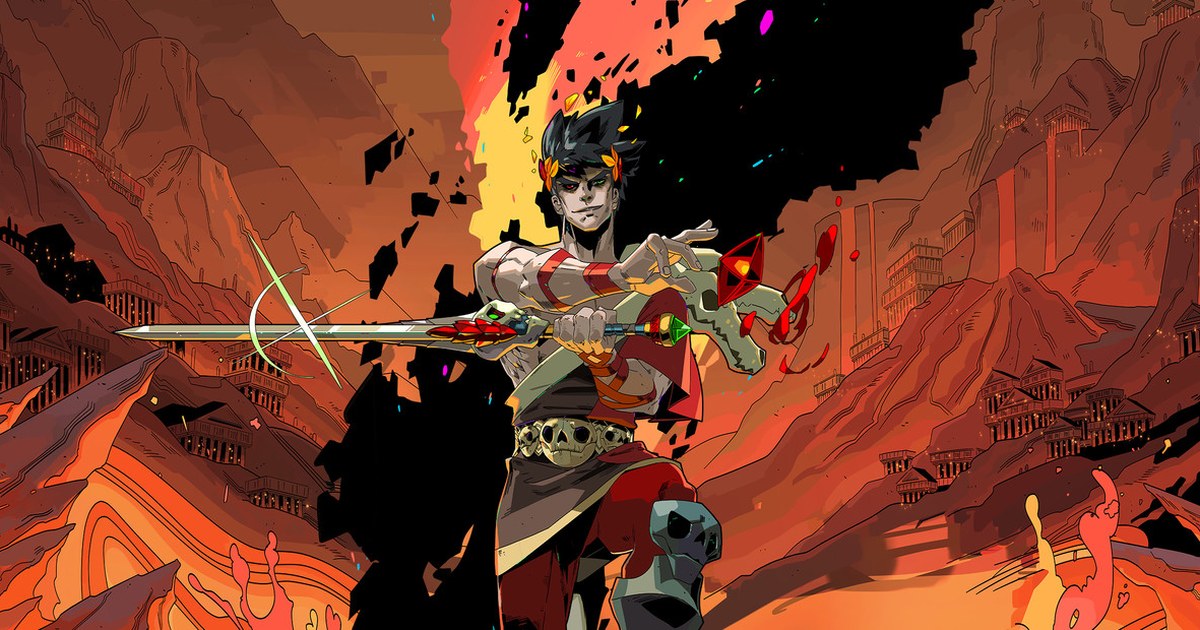
Hades
Verdict: Hades is a superb action roguelike and a family drama about a son escaping his father’s underworld. It’s also built, deliberately, around modern representation choices. The Greek gods were drawn as a multi-ethnic pantheon on purpose, Zagreus is written as bisexual with an optional same-sex romance and an optional three-way relationship, Achilles and Patroclus are a love story you can reunite, and Chaos is referred to as “they”. Creative director Greg Kasavin has said on record that the team wanted to show a world “with different values than the one that exists today”. What it doesn’t do is lecture: the romances are optional, the story isn’t about identity, the women are openly glamorous, and there’s no consultancy, pronoun menu or censorship anywhere.
Woke Score: 42/100. Clear, confirmed, creator-intended representation choices in casting and relationships, which our rules score. What keeps it in the low 40s: every romance is optional, Achilles and Patroclus and a neuter Chaos have real roots in the ancient sources, the plot is a father-son story rather than a message, the female designs are sexy rather than toned down, and no DEI consultancy, publisher pressure or censored build is involved.
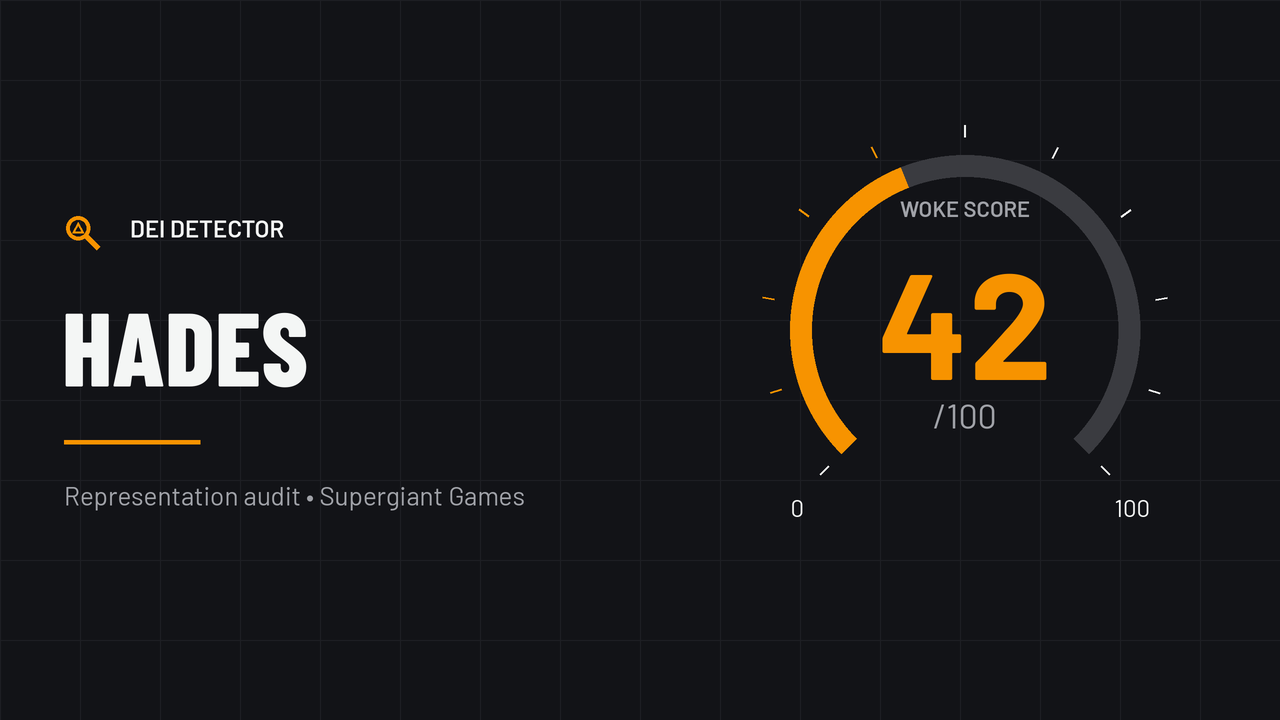
Woke Score graphic
This is the standing page for Hades (PC and Switch 2020, after Early Access from 2018; PlayStation and Xbox 2021). New evidence gets merged here; the URL stays fixed. The sequel has its own page: Hades II.
How the score breaks down
Scored against our How we score rules:
- Deliberately multi-ethnic pantheon (casting and design), +15. Kotaku (Ash Parrish, 22 Sep 2020) lists the choices: Athena is “a dark-skinned Black woman”, Dionysus is South Asian, Hermes is East Asian, and Eurydice is a Black woman with a tree-canopy afro. Kasavin told Kotaku the team decided the Olympians are “called the Greek gods because they were worshiped in ancient Greece, not because they themselves are ethnically Greek”, so “the gods represent all the people of the world”. An academic review in SFRA Review (Jan 2023) reads Athena’s skin as a nod to Black Athena and “the modern push against Eurocentrism”. That’s a stated, deliberate race-swap of figures traditionally drawn from Greek art, so it counts. It isn’t higher because these are gods rather than historical people, the game never frames it as a message, and plenty of the cast (Zeus, Poseidon, Artemis, Aphrodite) stays close to classical depictions.
- Bisexual lead with optional same-sex and polyamorous romance, +12. Zagreus can romance Megaera and Thanatos, and if both agree he can keep both relationships at once. Wired ran “‘Hades’ Nails Its Depictions of Polyamory and Kink” on it. TheGamer describes Zagreus as “developed as a bisexual main character”. His flirting with gods of both sexes is part of his voice whether you pursue anything or not. It’s short of full weight because every romance is optional and gated behind gifts, and the core story never depends on it.
- Creator intent, +10. Kasavin told TheGamer (Mar 2021): “The Ancient Greeks, in some respects, are more progressive as a society with some of their views than we are today. We wanted to express that in the game,” and a fantasy setting is “an opportunity to portray a world with different values than the one that exists today.” That’s an explicit statement that the relationship model was a values choice, not only fidelity to myth.
- Achilles and Patroclus, +3. A long optional side story reunites the two as lovers. Homer leaves their relationship open, but Aeschylus’s lost Myrmidons and Plato’s Symposium treat them as lovers, so this has real ancient backing. It counts only a little.
- Chaos as “they”, +2. Other characters refer to Chaos with they/them (Wired). In Hesiod, Chaos is a neuter primordial void, so a genderless Chaos is myth-rooted. It counts only a little.
- Track-record rule (rule B): not applied. We found no documented DEI mandate, consultancy history or censorship record for Supergiant.
- Consultancy check (rule A): none found. No sensitivity, cultural or DEI consultant in the credits (MobyGames), not in Sweet Baby Inc.’s documented gameography, and not on the “Sweet Baby Inc detected” Steam curator’s current list.
- Remake rule (rule C): doesn’t apply. It’s an original game. We found no reports of designs being softened between Early Access and 1.0 or in later ports.
- Rule D: nothing to count. Progressive outlets praised the game’s representation rather than attacking it. The one feminist complaint we found is a single paragraph in the glowing SFRA Review piece, calling the Persephone ending “a decidedly anti-feminist turn” because it shifts blame from Hades to Demeter. That’s a minor aside in a positive review, not an attack, so it doesn’t earn a green flag.
- Rule E (feminism): neutral, not scored. Megaera (a whip-wielding Fury in leather), Aphrodite (openly seductive), Nyx and Persephone are powerful and attractive in the traditional way, and the men aren’t written as fools for being men. Theseus is a pompous blowhard, but that’s a comic take on one hero, not a message about men.
Confirmed findings
- Casting and design: the multi-ethnic pantheon is intentional and explained by the creative director (Kotaku). The art director, Jen Zee, says the designs start from “the original, oldest myths we can find” and that the ancient Greeks’ own art was a frequent reference (Creative Bloq / ImagineFX; MCV/Develop). The ethnicity choices sit on top of that classical base.
- Relationships: Megaera and Thanatos are the romance options, Dusa can become a close friend, and the polyamorous option needs both partners’ agreement. It’s all optional, and nothing in the main escape story forces a romance.
- Myth-rooted queer content: Achilles and Patroclus (ancient lover readings), Orpheus and Eurydice (a straight couple you can also reunite), Theseus and Asterius as brothers-in-arms.
- Female presentation: unchanged since Early Access. Aphrodite is designed as a seductress, Megaera wears leather and carries a whip, and nothing was covered up between Early Access and release. There’s no de-sexing.
Checked and not confirmed (or ruled out)
| Talking point | Finding |
|---|---|
| DEI or sensitivity consultants credited | Ruled out. None in the credits or in reporting. |
| Pronouns menu, “representation” marketing campaign | Not found. We found no representation-themed marketing campaign; trailers and store pages sell the gameplay and story. |
| Designs toned down after Early Access or in ports | Not found. No reports of softened designs across Early Access, 1.0 or the PlayStation, Xbox or Netflix mobile versions. |
| Men written as useless or villains for being men | Ruled out. Zagreus, Hypnos, Thanatos, Achilles and Hades himself are all fully written; the story ends in a father-son reconciliation. |
| Censored regional build | Not found. Every platform and region has the same content. |
Cleanest version and regional notes
There’s no cleaner version: every platform and region has the same script and art, and the representation choices are part of the original game rather than a later edit. The English text and voice acting are the original; other languages are translations of it. If you want to avoid the optional romances, just don’t give Megaera or Thanatos ambrosia. The casting choices and Achilles’s side story can’t be avoided. For the sequel’s changes, see Hades II.
DEI Detector scorecard
| Signal | Present? |
|---|---|
| Deliberately multi-ethnic Greek pantheon, creator-explained | Strong (+15) |
| Bisexual lead; optional same-sex and polyamorous romance | Present (+12; optional) |
| Creator statement on “different values” | Present (+10) |
| Achilles and Patroclus as lovers | Present, myth-rooted (+3) |
| Chaos as “they” | Present, myth-rooted (+2) |
| DEI / sensitivity consultancy credited | Not found |
| Sexual / feminine censorship | Not found |
| Progressive press attack | Not found (one minor feminist aside, not scored) |
| Strong, attractive women (Megaera, Aphrodite, Nyx) | Neutral (rule E, not scored) |
| Regional censorship | None |
Open to update
This page will be revisited if:
- A sensitivity or DEI consultant turns up in credits or reporting (rule A would apply).
- Supergiant makes new statements about representation goals for the series.
Sources: Kotaku, “Black Athena: How Hades Gets Its Gods Right” (Ash Parrish, 22 Sep 2020, with Greg Kasavin’s emailed comments); TheGamer interview with Greg Kasavin (Jade King, 25 Mar 2021); Wired, “‘Hades’ Nails Its Depictions of Polyamory and Kink”; David Welch, review of Hades, SFRA Review 53.1 (Jan 2023); Creative Bloq / ImagineFX interview with Jen Zee (20 Jul 2024); MCV/Develop, “Behind the art of Hades”; MobyGames credits; Wikipedia’s Sweet Baby Inc. gameography and the “Sweet Baby Inc detected” Steam curator list (checked 26 Sep 2026). Anything marked “confirmed” is tied to developer statements or the game itself, and anything else is labelled as unverified.