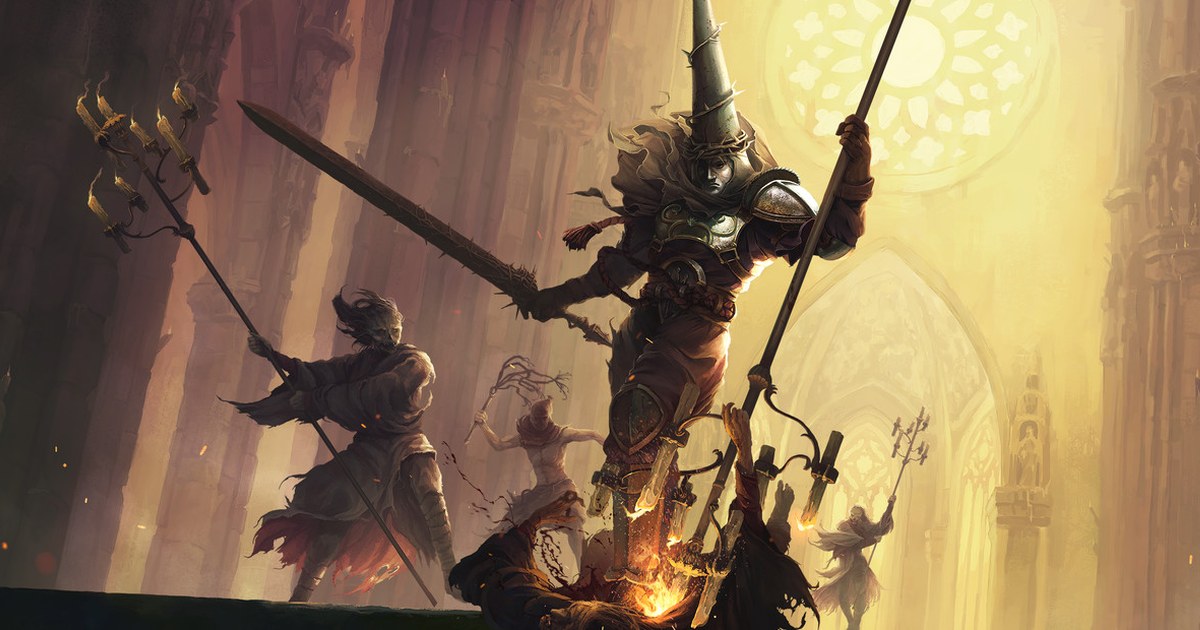
Blasphemous
Verdict: Blasphemous is a brutal 2D Metroidvania from The Game Kitchen, a studio in Seville, published by Team17. Its whole identity comes from Andalusian Holy Week processions, Baroque religious art and Spanish folklore, and its developers present that as a homage to their own culture, not an attack on religion. Nothing in the game, its three free updates or its ports was added or cut for representation reasons, and no consultant of any kind is credited. The women are knights, saints, martyrs and monsters out of Spanish legend, the nudity is still there on every Western version, and the English script’s differences from the Spanish are about tone, not ideology.
Woke Score: 0/100. We found no documented DEI or woke content, consultancy, mandate or censorship in the original game or its updates. The only edits we found reports of are in the Japanese console builds, which are regional ratings changes and don’t make the original woke.
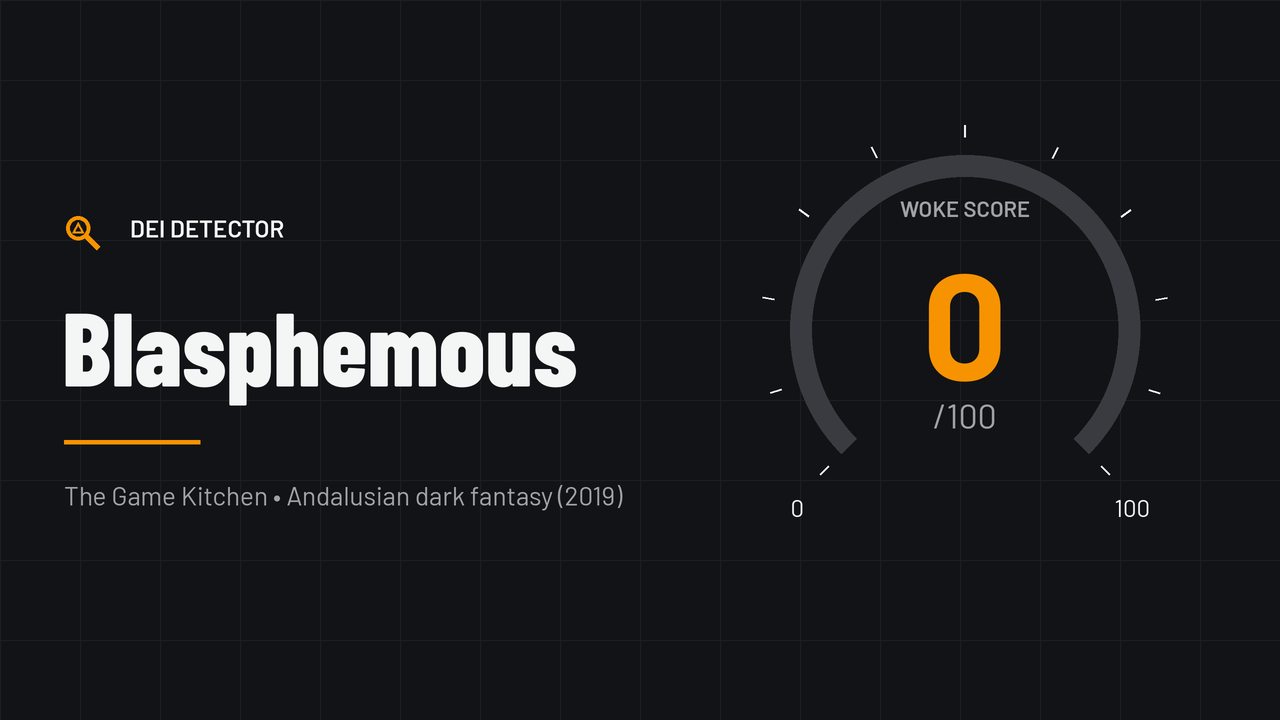
Woke Score graphic
This is the standing page for Blasphemous (PC, PS4, Xbox One and Switch, 10 Sep 2019; Mac and Linux 2020; iOS and Android 25 Nov 2024), including its free updates The Stir of Dawn, Strife and Ruin and Wounds of Eventide. New evidence gets merged here; the URL stays fixed. The sequel has its own page: Blasphemous II.
How the score breaks down
Scored against our How we score rules:
- Story, setting and creator intent: 0. The game began as a 2017 Kickstarter ($333,246 from 9,869 backers) built on one idea: dark fantasy made from Seville’s own religious culture. Creative director Enrique Cabeza told eldiario.es it is “a homage to our culture and a way of reclaiming it” (“un homenaje a nuestra cultura y una forma de reivindicarla”), and CEO Mauricio García told Vice that “no one has really exploited our cultural background to create dark fantasy.” There’s no representation goal in any interview, and no character was added to meet one.
- The religious imagery: 0. It’s neither a progressive critique nor a sermon; the developers treat it as folklore. Cabeza to Siliconera: “Of course, this is not a game against religion, but a game that is inspired by the iconography, atmosphere, elements, and feelings that are related to Christianity and our local folklore in southern Spain.” To Frieze: “here in southern Spain all that religious art is really more popular culture than religion.” And to Vandal (Oct 2023): “El juego no se mete con la religión, usa muchas cosas de la cultura porque la religión aquí es cultura” (“The game doesn’t go after religion; it uses a lot of the culture, because here religion is culture”). He adds that the game “has never received a political comment of any kind”, that people deeply involved in Holy Week and the brotherhoods “love it”, and that musicians from real brotherhoods played on the soundtrack. The in-game theology, a cruel and capricious divine force called the Miracle, is dark-fantasy horror. A Christian magazine read it as a critique of a certain kind of theology (Christ and Pop Culture, 2021); that’s one reading of the art, and it isn’t a DEI or progressive message either way.
- Free updates: 0. The Stir of Dawn (4 Aug 2020) added New Game+, new bosses (the four Amanecidas and Laudes) and a full Castilian Spanish voice track. Strife and Ruin (18 Feb 2021) added a Boss Rush, an 8-bit demake area and a crossover quest with Miriam from Bloodstained: Ritual of the Night, who asks the Penitent One to help her get home through a set of platforming challenges. Wounds of Eventide (9 Dec 2021) finished the story around Crisanta and set up the sequel. None of it is representation-driven.
- Women (rule E): neutral, not scored. Crisanta of the Wrapped Agony is an armoured knight-commander and the Penitent One’s rival; the Amanecidas and Laudes are undead warrior women sealed away by the Miracle; Miriam is Bloodstained’s anime-style heroine. Female saints like Our Lady of the Charred Visage and Altasgracias come straight from Spanish legends of pious women who disfigured themselves, or prayed to be made ugly, to escape a king’s advances or a forced marriage (María Coronel and Santa Librada). None of it is girlboss writing, and men aren’t written as fools for being men. The nudity is intact: the ESRB lists “Nudity” and notes “some creatures are depicted with exposed breasts and buttocks.”
- Consultancy check (rule A): none found. MobyGames lists 205 people: The Game Kitchen’s team, composer Carlos Viola, Persevoice Studios for the English voices, one English localiser (Lucía Prieto) and the Japanese localisation team. No sensitivity, diversity, cultural or narrative consultant is credited. The game isn’t in Sweet Baby Inc.’s documented gameography or on the “Sweet Baby Inc detected” Steam curator’s list (checked 29 Sep 2026), and we found no internal review team.
- Track-record rule (rule B): not applied. Team17’s documented controversies are about the workplace and business, not content: a 2022 Eurogamer investigation into low pay, crunch and HR handling of harassment complaints, and the withdrawn MetaWorms NFT project. We found no DEI mandate, consultancy work or censored release in its record, and nothing tying Team17 to changes in this game.
- Remake rule (rule C): doesn’t apply. It’s an original game. The Martyrs’ Edition and the 2024 mobile port carry the same content; the mobile store listings still flag nudity.
- Rule D (green flag): not found. We found no progressive or feminist press campaign against the game. Reviews argued about difficulty and controls, and the academic essays we found (Play the Past, 2022) analyse its “monstrous-feminine” figures rather than attack it. There are no red flags to offset anyway.
- Localisation: 0. The script was written in Spanish. Designer Maikel Ortega told Vice (2020) that the English version is a freer, archaic rewrite, because the old-village flavour of the Spanish “doesn’t translate well”: one boss’s speech “was rewritten as a Shakespearian kind of speech.” That’s a tone decision, not an agenda. We found no injected inclusive language or softened religious content in any translation.
Total: 0. Every line above scores zero.
Confirmed findings
- Where the imagery comes from: Cabeza’s team read Sevillian legend collections by José María de Mena and drew on Zurbarán, Velázquez, Goya, Ribera and the city’s architecture (eldiario.es, Oct 2019). The Penitent One’s capirote is the Holy Week penitent’s hood, which the Inquisition also used to mark the condemned. In English-speaking markets, Cabeza says, they had to explain it was a Catholic processional garment, not a Ku Klux Klan hood (Vandal).
- A character cut for resources, not content: the grotesque Cesareo, based on Ribera’s painting Magdalena Ventura with her Husband and Son, appeared in the art book but was left out of the 2019 game. Maikel Ortega said the character “demanded a lot of work (including a designated area) and we simply didn’t have the resources” (quoted by Play the Past). He appears in the sequel.
- Spanish voice acting: added free in The Stir of Dawn, directed by designer Enrique Colinet, with Spain’s dubbing voices for Tom Holland, Russell Crowe and Solid Snake among the cast (Vice).
- Publisher: Team17 published it after the Kickstarter; Cabeza says it was the publisher that was “closest to us at the time” (Vandal). Warp Digital handled the console ports.
Checked and not confirmed (or ruled out)
| Talking point | Finding |
|---|---|
| The game is an anti-Catholic or anti-religion statement | Not supported. The developers call it a homage to Andalusian culture and say it “doesn’t go after religion”; Holy Week brotherhood musicians played on the soundtrack. Critics’ theological readings are interpretation, not creator intent. |
| The capirote is a KKK reference | Ruled out. It’s the Holy Week penitent’s hood (Vandal, eldiario.es). |
| Diversity or LGBT content added by the updates | Not found. The updates added bosses, modes, Spanish voices and the Miriam crossover. |
| Nudity removed in Western console versions | Ruled out. ESRB lists Nudity for PS4, Xbox One and Switch, and players in the US, Europe and Australia report uncut Switch copies. One player reported a few background sprites missing in Albero on Switch; that’s unverified and not nudity-related. |
| DEI or sensitivity consultant credited | Ruled out. None in the MobyGames credits, the Sweet Baby gameography or the curator list. |
| English script rewritten for politics | Ruled out. The differences are stylistic and explained by the developers (Vice, 2020). |
Cleanest version and regional notes
Play the standard international version: PC (Steam), or the Western PS4, Xbox One or Switch releases, all of which have the same content. For the most authentic experience, switch the audio to Spanish (added in The Stir of Dawn): it’s the language the game was written in, and the English text is a freer adaptation. The Japanese console versions (Team17, localised by Kakehashi Games, CERO D, Dec 2019) reportedly cover some nudity; players have posted a Japanese stream showing Our Lady of the Six Sorrows with a covered chest. We found no official list of changes, so treat it as reported, not confirmed. Either way it’s regional ratings censorship, not a woke change to the original, and it doesn’t count against the score.
DEI Detector scorecard
| Signal | Present? |
|---|---|
| Representation added to story or cast | Not found (0) |
| Creator statement on representation goals | Not found (0) |
| Religious imagery used as an agenda | Not found (homage, per the developers) |
| DEI / sensitivity consultancy credited | Not found |
| Studio or publisher DEI track record | Not found |
| Sexual / feminine censorship (Western versions) | Not found |
| Girlboss writing (rule E) | Not found (Crisanta, the Amanecidas and Miriam are neutral) |
| Progressive press attack (rule D) | Not found |
| Localisation changes | Stylistic English rewrite only (0) |
| Regional censorship | Japan (reported, unconfirmed) |
Open to update
This page will be revisited if:
- A sensitivity, cultural or DEI consultant, or an internal review team, turns up in the credits or reporting (rule A).
- The Game Kitchen or Team17 says anything was cut, added or rewritten for representation reasons.
- A documented list of the Japanese version’s changes surfaces, or any translation is shown to inject political wording.
Sources: Siliconera, “Blasphemous Developers Talk About The Sources Of Its Horrifying Religious Imagery” (interview with Enrique Cabeza); Frieze, “How Video Game ‘Blasphemous’ Embraces the Catholic Gothic Tradition”; eldiario.es, “En el píxel está la penitencia” (14 Oct 2019); Vandal, “Enrique Cabeza, el hombre que ha llevado la imaginería religiosa española a los videojuegos” (Sara Borondo, 28 Oct 2023); Blog Lenovo interview with The Game Kitchen; Vice, “‘Blasphemous’ Was Written in Spanish. Now, Its Characters Finally Speak It” (Patrick Klepek, 2 Sep 2020); Nintendo Life on Strife and Ruin (16 Feb 2021) and Team17’s update announcements; Wikipedia’s Blasphemous article for release dates; ESRB rating summaries for Blasphemous and Blasphemous – Martyrs’ Edition; MobyGames Windows credits (archived Oct 2023); Wikipedia’s Sweet Baby Inc. gameography and the “Sweet Baby Inc detected” Steam curator list (checked 29 Sep 2026); Eurogamer, “Inside Team17, following the Worms NFT firestorm” (2022); Play the Past, “Feeling History in Blasphemous: Monstrosity and Spectacle through Time” (Jack Orchard, 22 Feb 2022); Christ and Pop Culture, “The Lurid Profanity of Blasphemous” (Lyle Enright, 8 Mar 2021); 4Gamer on the Japanese PS4 and Switch release (19 Dec 2019); r/Blasphemous player reports on Switch and Japanese versions; Google Play and App Store listings for the mobile port. Anything marked “confirmed” is tied to developer statements, credits, ratings or the game itself, and anything else is labelled as unverified.