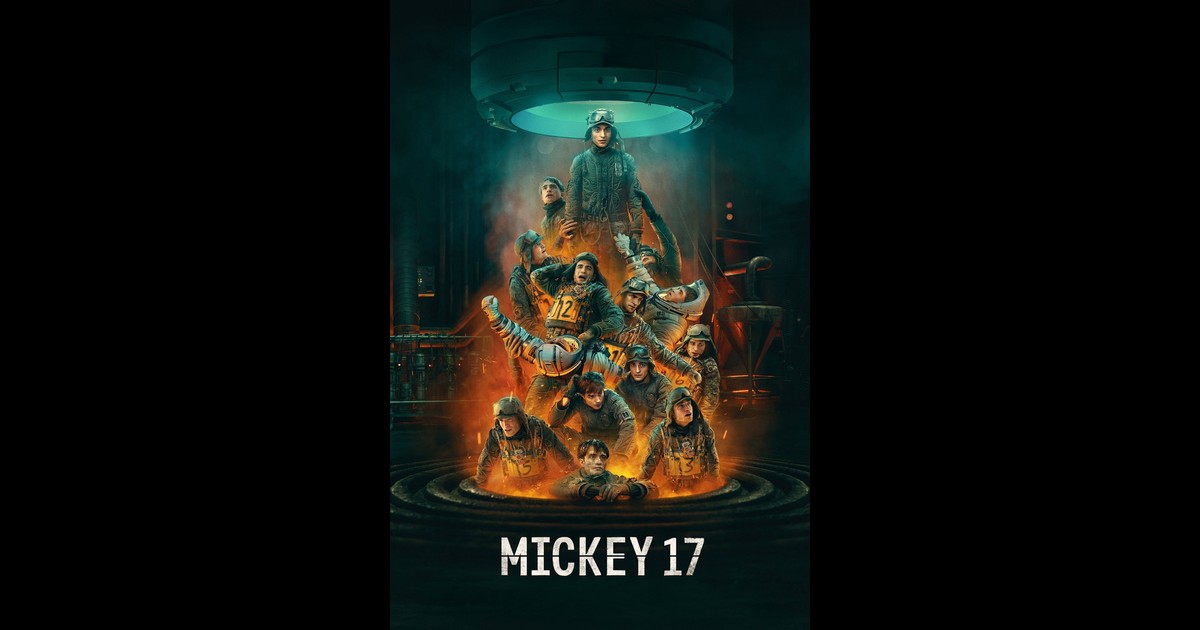
Mickey 17
Verdict: Mickey 17 is a clone farce with a progressive argument running through it. The villain is a red-hat demagogue selling a “pure white planet full of superior people.” The hero is labour the colony reprints like paper. The ending is a peace with the native creatures and the abolition of that job. Kai Katz is bisexual on screen, and that subplot is not in the novel. Bong says Marshall is not a portrait of one living politician. The pictures still count. There is no sensitivity firm, and Nasha is not a girlboss lecture.
Woke Score: 46/100. Five things score. The queer thread is a real addition but a side plot. The demagogue, the labour moral, the purity boast and the anti-colonial climax are what the second half is for.
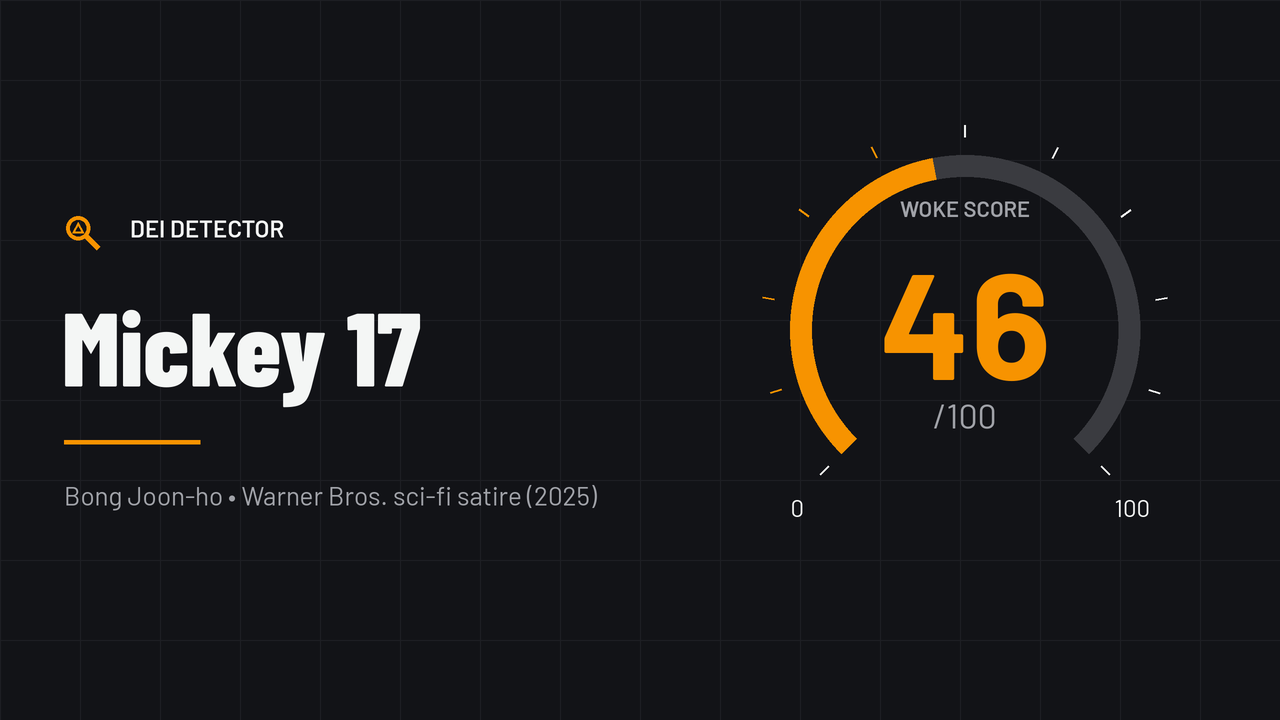
Woke Score graphic
This is the standing page for Mickey 17 (Warner Bros. Pictures, Plan B Entertainment, Offscreen and Kate Street Picture Company). World premiere 13 Feb 2025 at Leicester Square; Berlin 15 Feb 2025; South Korea 28 Feb 2025; United States and China 7 Mar 2025. 137 minutes. Written and directed by Bong Joon-ho, from Edward Ashton’s 2022 novel Mickey7. New evidence gets merged here; the URL stays fixed.
How the score breaks down
Scored against our How we score rules. Each beat is counted once.
- Kai Katz is bisexual, and the film added that, +8. In Edward Ashton’s novel the equivalent character is Cat Chen, a security guard who falls for Mickey. ScreenRant (Cooper Hood, 2025), comparing the book, says she is one of only two Asian women in the colony and connects with Mickey because Natalists fetishise both of them. The film renames her Kai, casts Anamaria Vartolomei, and gives her a girlfriend. Jennifer Chilton (Ellen Robertson) dies on the ice. Kai keeps their photos, asks Mickey what dying felt like, tries to kiss him, and asks if he and Nasha are open (Autostraddle, Kayla Kumari Upadhyaya, 13 Mar 2025). She ends the film with another woman. That is on screen, not an interview claim. It is +8, the same band as Kingdom Come: Deliverance II’s optional gay romance, not higher: Kai is supporting, nobody on the press tour called it a representation goal, there is no they/them or identity speech, and Autostraddle says the queerness is “dampened” (Kai never corrects Marshall when he calls Jennifer her “friend”). The book’s Asian-fetishisation beat does not survive. That removal is not scored again.
- Anti-Trump caricature, the pictures, +14. Kenneth Marshall (Mark Ruffalo) is a failed politician with a TV show, veneers, faintly orange skin, a rally dance and followers in red baseball caps (Slate, Mar 2025; The Guardian, 9 Mar 2025; Variety, 12 Feb 2025). The Nation called the Trump analogue “so obvious as to be a little embarrassing.” At the BFI, Bong said they shot in 2022, that “a particular thing that happened in 2024” resembled the film, and that Ruffalo asked if they had been “oracles predicting the future” (Variety). He still denies a one-man brief: Reuters (15 Feb 2025), Entertainment Weekly and Yonhap (20 Feb 2025) quote him calling Marshall a mix of past dictators, with the marriage pointing at the Ceaușescus and the Marcoses. Ruffalo told Yonhap and CNN the same. The denial is noted. The red hats, the rally and the orange demagogue are what score. The purity line is the next item, not this one.
- Anti-capitalist moral, +10. Mickey’s job is to die and be reprinted. Bong told SFX and POC Culture he dropped the novel’s historian so Mickey would be a working-class man who “has to die every day for his job.” He told Empire the printer gag is the point: humans “printed out of this printer, like a piece of paper.” The Atlantic (Mar 2025) reads the film as his class preoccupation taken into space. The ending states it: Nasha outlaws the Expendable programme and Mickey destroys the printer. Not higher, because Bong also told the Korea Herald the romance is the thing he kept from the book, and he told The Guardian he does not write “with the activist’s headband on.”
- “Pure white planet,” +8. At the rally Marshall says a “planet of purity” is waiting, then: “I’m creating a world on a pure white planet full of superior people. Like you. And us.” A hymn offers “a sea of white” (Scraps from the Loft transcript). ScreenRant, having read both, says the book’s Marshall is a Natalist commander who thinks printed people are not God’s creation. He has no programme for an ideal race. The film keeps a religious disgust at “multiples” and adds the race-colony boast. Autostraddle notes the crowd is not all white, so “white” can also mean the ice. The “superior people” line is still played as grotesque, which is why it scores. It is not counted again inside the Trump caricature.
- Native creatures, a climax the book doesn’t have, +6. Bong told News24 he kept the novel’s creepers but “wanted to imbue more meaning” into them: they mirror how the humans treat Mickey, and he gave them “depth and wisdom.” ScreenRant says the film’s baby-creeper sequence, Ylfa’s sauce from a tail, and the herd coming to the ship are not in the book. On screen Marshall means to wipe them out; Mickey warns the mother; a human death pays for the baby that was killed; the colony makes peace. That is the film pushing a colonial moral, not only a reviewer’s metaphor. RogerEbert.com also maps them onto immigration. Bong does not use that word, so immigration is not a separate line. +6, not more, because Bong’s own gloss partly repeats the labour point already scored: the creatures show how cheaply humans treat a life.
- Nasha and rule E: 0. Nasha Barridge (Naomi Ackie; Adjaya in the novel) is Mickey’s girlfriend. The scene with both Mickeys is two copies of the same man. Mickey 17 recoils when Mickey 18 touches him. That is a sex gag, not a bisexual identity. Ackie says Bong wanted the couple’s genders flipped in manner, and that Nasha’s Blackness “isn’t pushed as an issue” (Refinery29, 10 Mar 2025). Strong and sexual scores 0 under rule E.
- Consultancy (rule A): 0. No sensitivity reader, DEI advisor or Sweet Baby-style firm in the credits. Charles Yu is credited for additional literary material. Nothing public says which pages are his. Intimacy coordinator Adelaide Waldrop covered the sex scenes. That is not a diversity pass.
- Track record (rule B): not applied. Warner’s Inclusive Storytelling Guide dates from January 2024, after the shoot, and it is not a casting quota. No Warner marketing frame sold the film as a diversity title. Bong had final cut and said the studio respected it (Empire via IndieWire, 18 Oct 2024).
- Other book changes (rule C): 0 beyond the lines above. Ylfa is invented. Timo replaces the pilot Berto. Ashton told Arakat that grey areas became “vivid black and white.” Those are adaptation. The political swaps are already in the +8, the +14, the +8 and the +6.
- Press (rule D): not applied. Praise is not a discount. Pans in The Nation, the New Statesman and BBC Culture say the satire is clumsy.
- Climate, disability, pronouns: 0. Colonists treat Earth as not worth fixing (Vulture notes the line). That is why they leave. It is not a climate sermon, and Bong has not framed the film as one. Nothing found on a disabled lead or on they/them speech. “17” is the reprint number. Bong told the Korea Herald he picked it because 17 and 18 sit on the edge of adulthood.
Total: 8 + 14 + 10 + 8 + 6 = 46.
Relationship map
| Who | What the film shows | In the book |
|---|---|---|
| Nasha and Mickey | Central romance. She has sex with Mickey and starts a scene with both copies. She ends as colony leader. | Nasha Adjaya, a pilot, already Mickey’s lover. The threesome is in the novel (ScreenRant, CBR). |
| Mickey 17 / Mickey 18 | 17 is meek and straight. 18 is violent and willing to touch 17 during the sex scene. 17 rejects it. No identity speech. | The two Mickeys are almost the same person. |
| Kai Katz | Supporting. Girlfriend Jennifer, photos, a kiss attempt on Mickey, a new girlfriend at the end. Several scenes, not the lead. | Cat Chen, an Asian woman who falls for Mickey and then betrays the multiples (ScreenRant). No girlfriend. |
Confirmed findings
- Bong sees the resemblance and still hedges. Variety’s BFI report is the closest he comes: orange skin, a 2024 event that looked like the film, Ruffalo’s “oracles” line. Reuters, Yonhap and Entertainment Weekly are the denial.
- The labour point is in his words. Working-class Mickey, printing as an inkjet, a destroyed printer at the end.
- The purity boast and the creeper peace are his changes to Ashton. ScreenRant’s book comparison is the source for what the novel’s Marshall and creepers do not do. Bong’s News24 interview is the source for why the creatures got “more meaning.”
- Final cut. The March 2024 date moved for the SAG-AFTRA strike and later calendar swaps (Variety, Hollywood Reporter, Deadline). Bong says the released film is his.
Checked and not confirmed (or ruled out)
| Talking point | Finding |
|---|---|
| Warner sold it as a diversity film | Nothing found. The studio pages and press notes sell a Pattinson sci-fi comedy. |
| They/them, a nonbinary character, or a pronoun speech | Nothing found. |
| A disability theme | Nothing found. |
| A climate lecture | Not as its own thread. Earth is the place they are fleeing. Not scored separately. |
| Creepers as an immigration allegory in Bong’s mouth | Not found. RogerEbert.com uses that frame. Bong talks about dignity and how humans treat Mickey. The colonial plot is scored once, above. |
| Multiples as a trans metaphor | A reviewer’s reading only. Autostraddle says you can read “crimes against nature” that way. The film states a religious panic about two copies of one man. Not scored. |
| A DEI consultant wrote the politics | Nothing found. Charles Yu’s pages are undescribed. |
| China cut the jokes | Nothing found. It opened 7 Mar 2025 as 编号17 (Korean Film Council; Maeil Business). No cut list. |
| The India version is the original | No. Mid-Day, via Newsbytes (5 Jan 2025), reported the studio pre-cut the threesome so the Indian run is about four minutes shorter. The CBFC then passed that shorter cut. That is local self-censorship. It does not raise the score. |
Cleanest version and regional notes
Watch the standard international cut: US, UK, Korea, China, or the digital release of 8 Apr 2025 and Max from 23 May 2025. Bong says that is his cut, and it keeps the sex and the politics. Skip the Indian theatrical version if you want the threesome. A regional trim does not make the original woke, and it does not remove the satire from the versions above.
DEI Detector scorecard
| Signal | Present? |
|---|---|
| Bisexual character, added from the book | Yes, supporting (+8) |
| Anti-Trump caricature (red hats, orange skin, rally, TV) | Yes (+14) |
| Anti-capitalist / expendable-labour moral | Yes, in Bong’s words (+10) |
| “Pure white planet” / superior-people boast | Yes, added from the book (+8) |
| Native-creature climax (genocide averted, peace) | Yes, Bong added the meaning (+6) |
| DEI consultancy (rule A) | Not found |
| Studio quota or diversity marketing (rule B) | Not applied |
| Girlboss writing (rule E) | Not found |
| They/them, disability, climate sermon | Not found |
| Progressive-press attack (rule D) | Not found |
| Western censorship | Not found |
| Regional cut | India, reported (sex scene) |
Open to update
This page will be revisited if:
- Ashton or Bong contradicts the Cat Chen comparison, or a primary quote shows Kai’s girlfriends were in the draft he adapted.
- A credit, WGA notice or interview says what Charles Yu wrote.
- A China cut list appears, or the India trim is shown to have removed political lines rather than the sex scene.
Sources: Autostraddle (Kayla Kumari Upadhyaya, 13 Mar 2025); ScreenRant, Cooper Hood, on Cat Chen, and Greg MacArthur, “12 Biggest Book Changes In Mickey 17” (10 Mar 2025); CBR on the book changes; Scraps from the Loft transcript of the rally; Slate (Mar 2025); The Guardian review (9 Mar 2025) and Bong interview (22 Feb 2025); Variety, BFI (Naman Ramachandran, 12 Feb 2025); Reuters (15 Feb 2025); Yonhap (20 Feb 2025); Entertainment Weekly; CNN; The Nation; The Atlantic (Mar 2025); News24 Q&A with Bong on the creepers; The Korea Herald on the romance and the number 17; Vulture on Earth; RogerEbert.com on immigration and colonisation; Refinery29, Naomi Ackie (10 Mar 2025); Empire via IndieWire (18 Oct 2024); Edward Ashton in Arakat; SFX and POC Culture; ComingSoon on the MPA R rating; Newsbytes citing Mid-Day (5 Jan 2025) and the Free Speech Collective log on the Indian cut; Korean Film Council and Maeil Business on the China opening; Warner Bros. on the Max date. Book-to-film claims are pinned to the comparison pieces, not to a fresh reading of the novel.