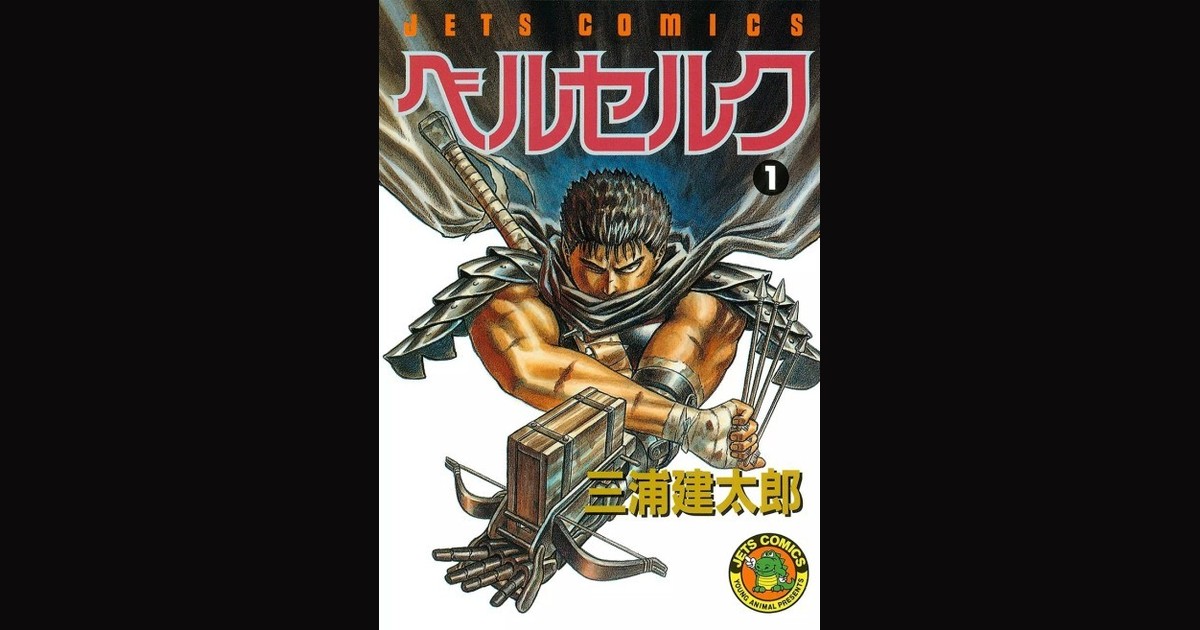
Berserk
Verdict: Berserk is faithful grimdark dark fantasy (Kentaro Miura; continuation credited to Studio Gaga under Kouji Mori supervision after Miura’s death) — not a progressive DEI product. Graphic violence and sexual assault are story trauma and horror, not “woke.” Score carefully: agenda push ≠ dark themes; feminist / progressive readings of Casca or masculinity are reception, not Miura packaging Berserk as HR training. Dark Horse’s English edition was explicitly pledged uncensored / not Westernized at launch.
Woke Score: 18/100 — residual points for progressive critical reframing in secondary essays; heavily offset because the text remains merciless medieval horror, Dark Horse did not DEI-sanitise the pages, and Studio Gaga’s brief is fidelity to Miura’s ending under Mori — not a progressive reboot.
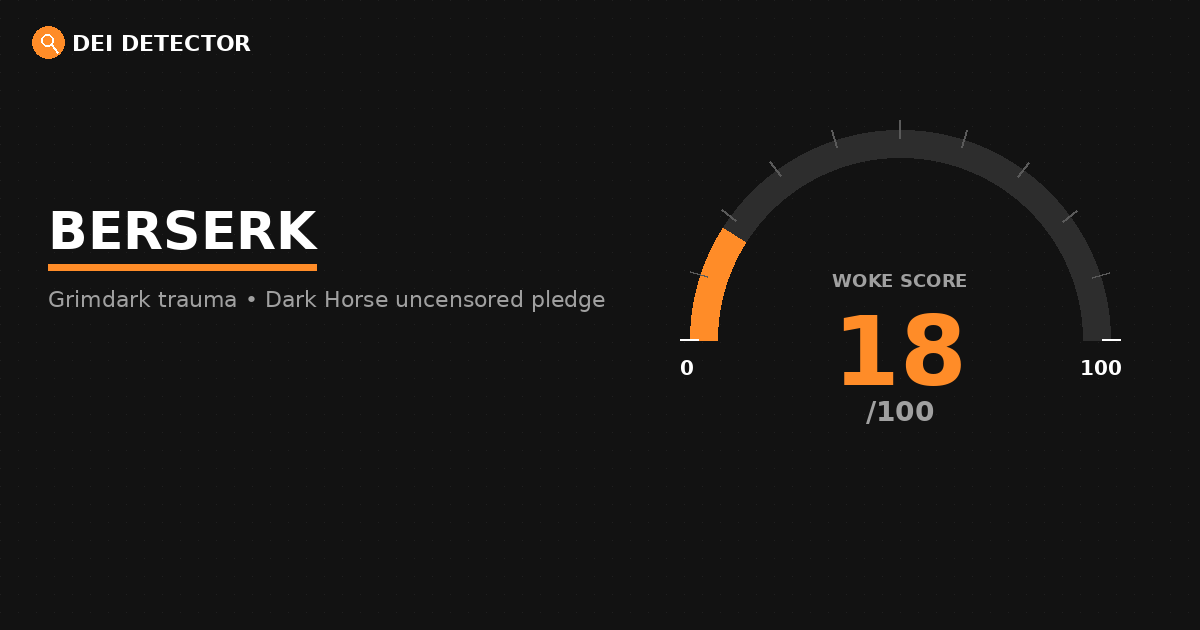
Woke Score graphic
This is the standing page for Berserk (manga). New evidence gets merged here; the URL stays fixed. Distinguish Miura eras, Studio Gaga continuation, and anime adaptations (1997 / movies / 2016–17) when scoring — this page’s primary object is the manga.
How the score breaks down
Scored against our How we score rules:
- Low base: a few points for progressive critical reframing in secondary essays (reception, not Miura’s intent).
- Rule E (feminism): neutral, not scored. Casca is one of the Band of the Hawk’s best fighters, a unit commander, and half of the series’ central straight romance. She’s written as a character, not a message, and the men around her aren’t made fools. Feminist essays about her are reception, not Miura’s intent. That’s the traditional kind of strong, attractive women, which our rules treat as expected, so it neither adds nor takes off points.
- Checks: no DEI consultancy (rule A), no track-record trigger (rule B), and Dark Horse’s English edition was pledged uncensored (no rule C issue).
Confirmed: grimdark trauma ≠ DEI agenda
Public, attributable patterns:
- Berserk follows Guts through mercenary war, the Eclipse, apostles, and Casca’s assault/trauma — horror and tragedy, not a representation checklist
- Miura’s interviews (fandom archives of magazine talks) discuss Casca’s trauma as something the story would eventually confront; that is character/trauma craft, not a DEI press kit
- Studio Gaga continuation (ANN 2022-06-07): credits “Original work by Kentarō Miura, manga by Studio Gaga, supervised by Kouji Mori” — Mori states he discussed the ending with Miura and aims to tell that story. That is authorial continuity, not a studio DEI rewrite
Rule applied: graphic sexual violence on-page is not automatically progressive messaging; do not score “woke” for depicting atrocity, and do not excuse atrocity as progressive either — score authorial agenda, not shock content alone.
Confirmed: Dark Horse localisation — uncensored pledge, not DEI scrub
Dark Horse / Digital Manga launch (2003 press; Chris Warner interview 2003-09-01):
- Will not Westernize; right-to-left
- Will not be altered, censored, or “sanitized”
- Content advisory / shrink-wrap for retailers — not page scrubbing
Documented English debates are mostly translation taste (Hawk vs Falcon, causality vs fate, tone of Guts’s swearing vs fan scans) — not pronoun activism or body censorship as the headline vector. Treat fan-scan “edgier swears” nostalgia as reception, not proof Dark Horse ran a progressive sensitivity pass.
Clean / faithful sources (name them)
- JP Young Animal / Hakusensha tankōbon (and Deluxe JP equivalents)
- Dark Horse English singles and Deluxe hardcovers — publisher-on-record as uncensored vs Westernisation
- Prefer these over random scan quality arguments when the claim is “official EN censored Berserk”
Partial: progressive / feminist reception — label it
Anime Feminist and similar essays read Casca through race/gender lenses (e.g. “Strong Black Woman” myth critiques). Fandom threads debate misogyny vs critique-of-misogyny. Label those as reception. They do not convert Miura’s 1989–2021 serial into a DEI marketing product, and they do not erase the Eclipse’s brutality.
Do not fabricate Miura quotes claiming Berserk was written as a modern DEI allegory.
What this is not
- Depicting rape/atrocity ≠ “the manga is woke”
- Depicting rape/atrocity ≠ “the manga is automatically anti-woke either” — score agenda, not vibes
- Studio Gaga ≠ “woke replacement artists” without evidence; public brief is Miura/Mori continuity
- Translation quibbles (causality/fate, swear intensity) ≠ DEI localisation
DEI Detector scorecard
| Signal | Present? |
|---|---|
| Progressive / DEI story agenda as core pitch | Weak / absent |
| Graphic SA / violence as grimdark content | Strong — ≠ woke by itself |
| Feminist / progressive critical reframing | Present — labelled reception |
| Dark Horse uncensored / no-Westernize pledge | Strong (2003 on record) |
| Pronouns / HR-checklist packaging | Absent |
| Studio Gaga continuation as DEI reboot | Not established |
| Faithful JP + Dark Horse editions available | Strong |
| Strong, attractive, straight female lead in the manga tradition (Casca) | Neutral (rule E, not scored) |
Recommendation
Read Berserk as Miura’s (and Studio Gaga/Mori’s continued) grimdark epic — expect extreme content. Prefer Hakusensha tankōbon or Dark Horse / Deluxe for the official uncensored English path. Do not inflate the woke score because progressive critics wrote Casca essays; do not confuse horror with DEI packaging. Update if a future official edition ships a documented progressive rewrite or body scrub.
Sources include Dark Horse 2003 Berserk press (“will not be censored or westernized”); Chris Warner Dark Horse interview 2003-09-01 (no sanitize / no Westernize at Miura’s request); ANN 2022-06-07 on Studio Gaga / Kouji Mori continuation credits; Dark Horse Deluxe publication notes; feminist/progressive Casca essays noted as reception (e.g. Anime Feminist). Translation-taste debates summarised from public reader comparison threads. No fabricated Miura “Berserk is DEI” quotes.